

How to Control Saturday Queues in a Busy Barbershop
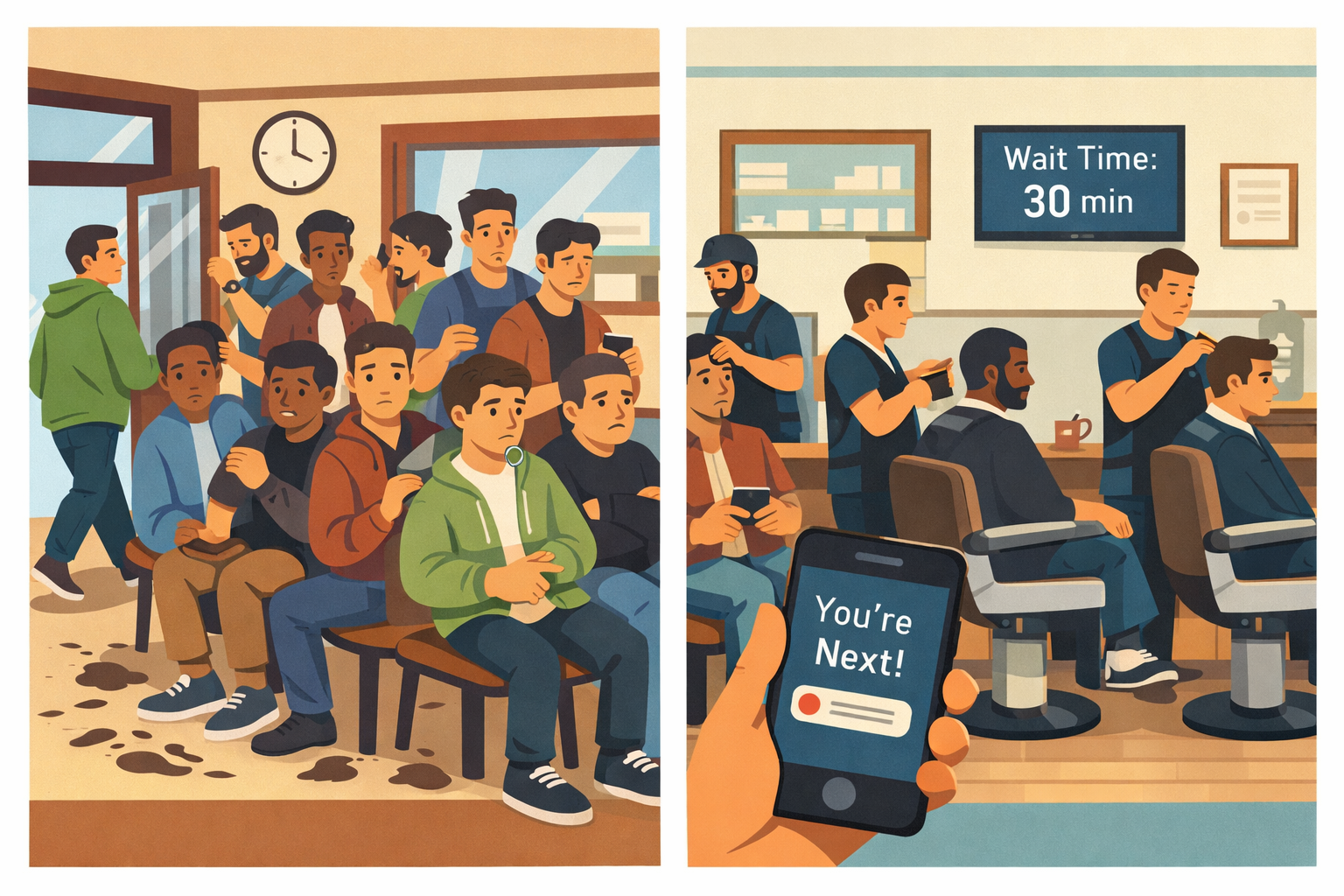
Saturday is make-or-break.
For most UK barbershops, Saturday generates 25–40% of weekly revenue — yet it’s also the day when:
Walk-ins bounce
Waiting areas overflow
Staff feel overwhelmed
New customers leave before even asking the wait time
The problem isn’t demand.
The problem is unmanaged demand.
If you can master controlling Saturday queues, you turn chaos into controlled profitability.
Let’s break down the exact peak-hour strategy.
Why Saturday Queues Get Out of Control
Peak compression happens when:
• Everyone arrives between 10am–1pm
• Average haircut time stays 20–30 minutes
• Customers visually assess the queue (not the real wait time)
• No visibility of expected wait
Example:
6 chairs × 25 minutes = 12 customers per hour capacity
But 25 customers walk in between 11–12.
That creates a 13-customer overflow instantly.
Without structure, that’s where customers leave.
The Real Cost of Losing Peak Customers
If 5 customers walk out on Saturday:
5 × £22 average cut = £110
Over 50 Saturdays = £5,500 per year
And that’s conservative.
You’re not just losing revenue.
You’re losing lifetime value.
Step 1: Forecast the Saturday Surge
Track:
• Average arrivals by hour
• Average service time
• Chair utilisation
• Walk-out rate
After 3–4 weeks, you’ll see a clear pattern:
Usually:
9–10am: steady
10–1pm: surge
1–3pm: taper
After 3pm: manageable
Once you know the surge window, you plan for it — not react to it.
Step 2: Create Visual Queue Certainty
Customers don’t mind waiting.
They mind uncertainty.
When someone walks in and sees 10 people waiting, their brain says:
“That’s an hour.”
But that’s often wrong.
If you want real control, you need a system that manages perception and flow — not just chairs.
This is where digital systems built specifically for a barbershop queue management system change everything.
Instead of:
❌ “How long is it?”
You show:
✅ “Estimated wait: 28 minutes.”
That alone reduces walk-outs dramatically.
Step 3: Remote Joining During Peak
The biggest Saturday advantage:
Let customers join before they arrive.
When clients can:
• Join from home
• Join from the car
• See real-time updates
• Get notified when nearly up
You reduce:
Physical crowding
Visual intimidation
Walk-in bounce
This is how serious shops start
controlling Saturday queues instead of reacting to them.
Step 4: Adjust Staffing Strategically
Peak hour isn’t just about more staff — it’s about the right timing.
Instead of:
❌ All staff starting at 9am
Try:
✔ Staggered start times
✔ Extra barber 10–2 only
✔ Break rotation outside surge window
If your busiest hour is 11–12,
that’s where your maximum capacity must sit.
Step 5: Turn Peak into Premium
Advanced strategy:
Some shops use peak visibility to:
• Upsell treatments
• Promote beard add-ons
• Offer express slots
• Introduce loyalty incentives
When wait time is transparent, customers feel in control — and are more open to add-ons.
Real Example: Controlled vs Uncontrolled Saturday
Uncontrolled:
• 15 visible waiting
• 6 leave
• Stress high
• Staff rushing
• Reviews suffer
Controlled:
• 15 in system
• 6 remote
• Clear 35-minute estimate
• Staff steady
• Revenue maximised
Same demand.
Different management.
The Psychological Advantage
Saturday chaos creates:
• Staff stress
• Customer impatience
• Reduced service quality
Structured queue control creates:
• Calm atmosphere
• Predictable flow
• Higher perceived professionalism
• Better Google reviews
Customers associate smooth flow with high standards.
Technology + Tactics = Peak Control
Modern shops don’t rely on:
“Just wait mate.”
They rely on:
• Digital join
• Live visibility
• Real-time updates
• Fair rotation
• Data tracking
That’s how you shift from reactive barber to operationally strategic business.
FAQs: Controlling Saturday Queues in Barbershops
How do barbershops handle busy Saturdays?
Barbershops handle busy Saturdays best by forecasting peak hours, staggering staff shifts, keeping breaks outside the surge window, and giving customers clear queue visibility with accurate wait estimates.
Why do customers leave during peak hours at a barbershop?
Most customers leave due to uncertainty rather than the wait itself. If they can’t see an accurate wait estimate, they assume the queue will take too long and may walk out before asking.
What is the best way to reduce walk-outs on Saturdays?
Reduccing walk-outs on Saturdays comes down to controlling Saturday queues with clear wait-time visibility, better peak staffing, and a process that prevents the waiting area from looking overcrowded.
How can I control Saturday queues without hiring more barbers?
You can control Saturday queues by staggering start times, moving breaks outside the peak window, tightening service menus during the surge, and using a structured queue process that keeps customers informed of real wait times.
What hours are usually peak hours for barbershops on Saturdays?
Peak hours vary by location, but many barbershops see the biggest Saturday surge between late morning and early afternoon. Track arrivals by hour for 3–4 weeks to identify your exact surge window.
How do I stop the waiting area from feeling overcrowded on Saturdays?
The quickest fix is reducing visible waiting. Let customers wait off-site when possible, provide live wait-time updates, and use notifications so people return when they’re nearly up—this keeps the shop calmer and queues feel shorter.
Does showing wait times actually reduce walk-outs?
Yes. Showing a realistic wait estimate reduces uncertainty, which is one of the main drivers of walk-outs. Customers are more likely to stay when they know what to expect.
What is the simplest peak-hour strategy for a small barbershop?
Start with three things: identify your busiest Saturday hour, schedule your strongest staffing for that hour, and make the queue predictable by giving customers clear information about their position and expected wait.
How do you keep service quality high during Saturday rush?
Protect quality by planning breaks outside the surge, keeping the service menu focused during peak, and using a structured queue process so staff aren’t constantly disrupted by wait-time questions.
Should I allow customers to join a queue before arriving at the barbershop?
Yes—remote joining is one of the most effective ways of controlling Saturday queues. It reduces visible crowding, lowers walk-outs, and improves customer experience by letting people wait elsewhere.