

Queue Management System Statistics: US Wait Time Data
Waiting is no longer just an inconvenience for US businesses. It directly impacts customer satisfaction, walkouts, staff pressure, revenue, and the overall customer experience.
Whether customers are waiting in retail stores, restaurants, healthcare environments, barbershops, or service businesses, the way that wait is managed often determines whether they stay, leave, or return.
This page brings together key US queue management system statistics, helping explain why businesses are adopting digital solutions. If you're new to the concept, this guide explains exactly what a queue management system is and how it works.
Key US Queue Management Statistics
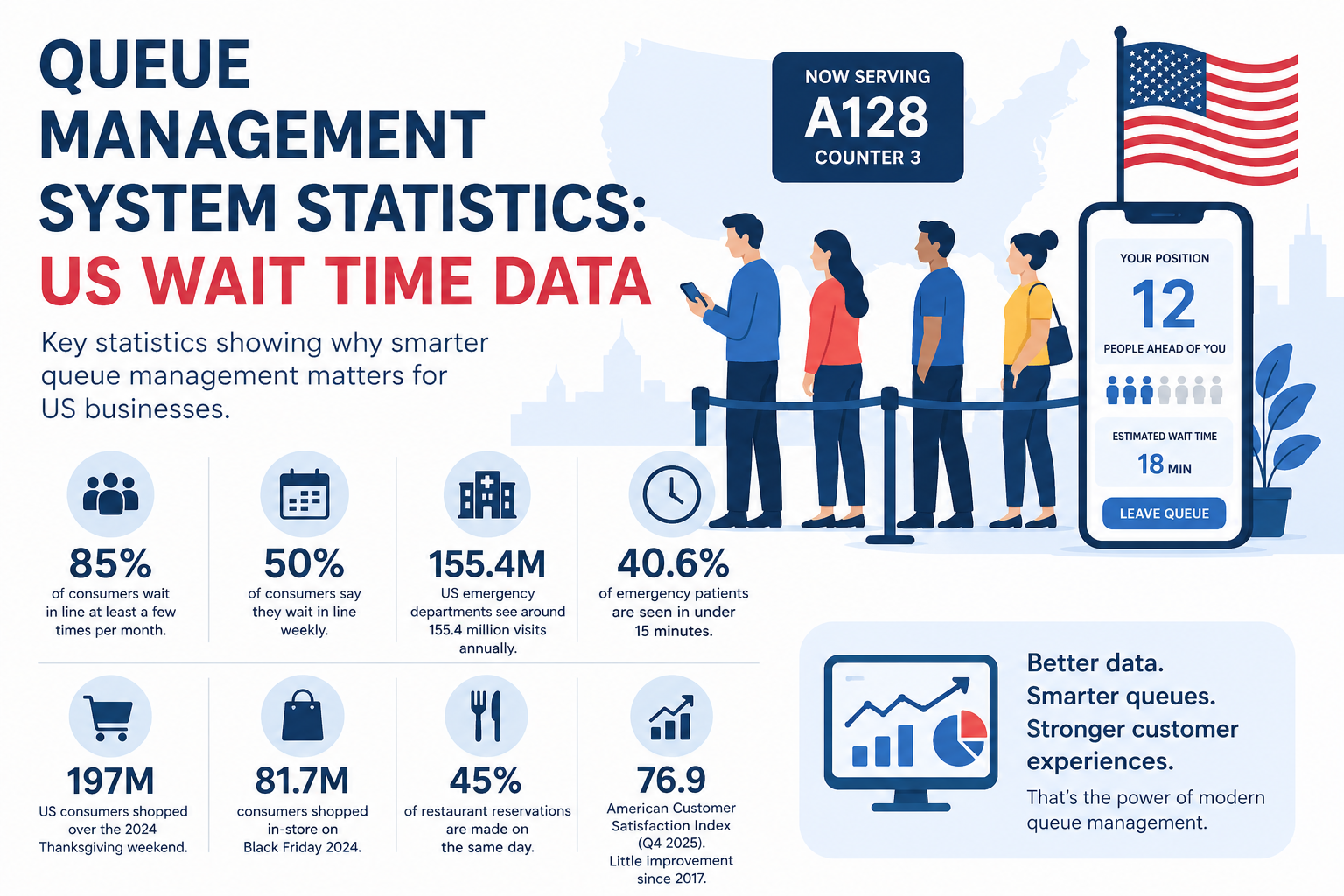
85% of consumers report waiting in line at least a few times per month
50% of consumers say they wait in line weekly
US emergency departments see around 155.4 million visits annually
Only 40.6% of emergency patients are seen in under 15 minutes
197 million US consumers shopped over the 2024 Thanksgiving weekend
81.7 million shopped in-store on Black Friday 2024
45% of restaurant reservations are made on the same day
The American Customer Satisfaction Index sits at 76.9 and has shown little improvement since 2017
These numbers highlight one clear truth: waiting is still a major part of the customer journey — and businesses that manage it better gain a competitive edge.
Why Queue Management Matters in the United States
US consumers are used to speed and convenience. They can track deliveries, order food instantly, and receive real-time updates for almost everything.
That expectation now applies to waiting.
Customers no longer accept standing in a line without information. They want to know:
How long will I be waiting?
Where am I in the queue?
Can I leave and come back?
Will I lose my place?
Will I be notified when it’s my turn?
A queue management system answers these questions. Instead of relying on staff to manually manage every person waiting, businesses can organise flow digitally, display wait times, and send updates automatically.
Consumer Waiting Line Statistics
Research shows that 85% of people wait in line at least a few times per month, with half experiencing queues weekly.
This means waiting is not occasional — it’s frequent.
For businesses, every queue becomes a decision point. Customers may:
Stay and wait
Leave before being served
Abandon a purchase
Decide not to return
This is why queue management isn’t just operational — it’s commercial.
It directly affects revenue and retention.
These trends explain why more businesses are turning to structured solutions like a queue management system to improve flow, reduce uncertainty and keep customers engaged while they wait.
Retail Queue Statistics in the US
Retail is one of the most affected industries when it comes to queues.
Many retailers now rely on a digital queue management system to handle peak demand, improve checkout flow and reduce lost sales during busy periods.
During the 2024 Thanksgiving shopping period, 197 million consumers shopped across five days. Black Friday alone saw 81.7 million in-store shoppers.
That level of demand creates pressure across:
Store entrances
Checkout areas
Customer service desks
Click-and-collect points
Returns counters
Poorly managed queues in retail can lead to:
Lost sales
Basket abandonment
Negative reviews
Reduced repeat visits
Increased staff stress
A retail queue management system gives customers visibility and gives staff control. Instead of standing in a physical line, customers can join digitally, track progress, and return when needed.
Healthcare Queue Statistics in the US
Healthcare highlights the importance of queue management even more clearly.
The US records around 155.4 million emergency department visits per year, yet only 40.6% of patients are seen within 15 minutes.
While wait times in healthcare cannot always be reduced due to prioritisation and clinical needs, the experience of waiting can still be improved.
A healthcare queue management system or virtual waiting room can:
Reduce crowded waiting areas
Improve patient communication
Help manage arrivals more efficiently
Reduce pressure on front desk staff
Provide visibility into patient flow
The goal isn’t to replace decision-making — it’s to make waiting more transparent and less stressful.
Restaurant and Hospitality Queue Statistics
In hospitality, demand has become more unpredictable.
Data shows that 45% of restaurant reservations are made on the same day, meaning businesses must manage both planned bookings and spontaneous walk-ins.
This creates pressure during:
Peak dining times
Weekends
Events
Seasonal spikes
Queue management helps hospitality businesses:
Manage walk-ins alongside bookings
Organise waitlists efficiently
Notify guests when tables are ready
Reduce overcrowding at entrances
Improve the guest experience
For customers, the difference is simple: they can wait without standing still.
Customer Satisfaction and Waiting
The American Customer Satisfaction Index has remained relatively flat at 76.9 for years, showing that improving customer experience is becoming harder.
This is where operational experience becomes critical.
Customers don’t just judge a business on its product or service — they judge it on how easy the experience feels.
Waiting plays a major role in that perception.
If customers feel ignored, uncertain, or frustrated while waiting, it damages the overall experience — even if the service itself is good.
What These Statistics Mean for Businesses
These statistics highlight why many businesses are now moving toward digital solutions. A modern queue management system allows businesses to manage customer flow, reduce walkouts, and improve the overall waiting experience without adding complexity.
The data points to one clear conclusion:
Waiting is unavoidable. Poorly managed waiting is not.
Businesses don’t always need to eliminate queues — but they do need to improve how those queues are experienced.
That means:
Providing visibility
Communicating clearly
Reducing uncertainty
Giving customers flexibility
A queue management system transforms waiting from a problem into a controlled, predictable experience.
These statistics highlight a clear shift in customer expectations. Businesses that implement a queue management system for businesses are better positioned to manage demand, reduce walkouts and deliver a more controlled customer experience.
How QueueAway Helps Manage Waiting
QueueAway is a web-based queue management system designed to reduce physical queues and improve customer flow.
Customers can join a queue by scanning a QR code or tapping a link — no app download required.
Once in the queue, they can:
See their position
View estimated wait time
Track progress in real time
Receive updates when they are nearly ready
This allows customers to step away, rather than stand in line.
QueueAway is used across:
Retail
Barbershops
Hospitality
Healthcare
Events and brand activations
Customer service environments
For businesses, it creates a calmer, more controlled front-of-house.
For customers, it makes waiting more flexible and less frustrating.
If you're exploring solutions based on the data above, understanding how a queue management system works is the next step before choosing the right system for your business.
Frequently Asked Questions
What is a queue management system?
A queue management system is a digital tool that helps businesses organise waiting customers, manage flow, and improve the overall waiting experience.
Why do US businesses need queue management systems?
Because customer expectations have changed. People now expect real-time updates, flexibility, and visibility when they are waiting.
What industries use queue management systems?
Retail, healthcare, hospitality, restaurants, barbershops, events, and customer service businesses all use queue management systems.
How does a virtual queue system work?
Customers join a queue using their phone, track their position, and receive notifications when it is their turn, removing the need to stand in line.
Does queue management reduce wait times?
It can improve efficiency and reduce actual wait times, but more importantly, it improves perceived wait times by making the process clearer and more predictable.