

Walk-In Barbershop Management: Challenges, Systems & 2026 Trends
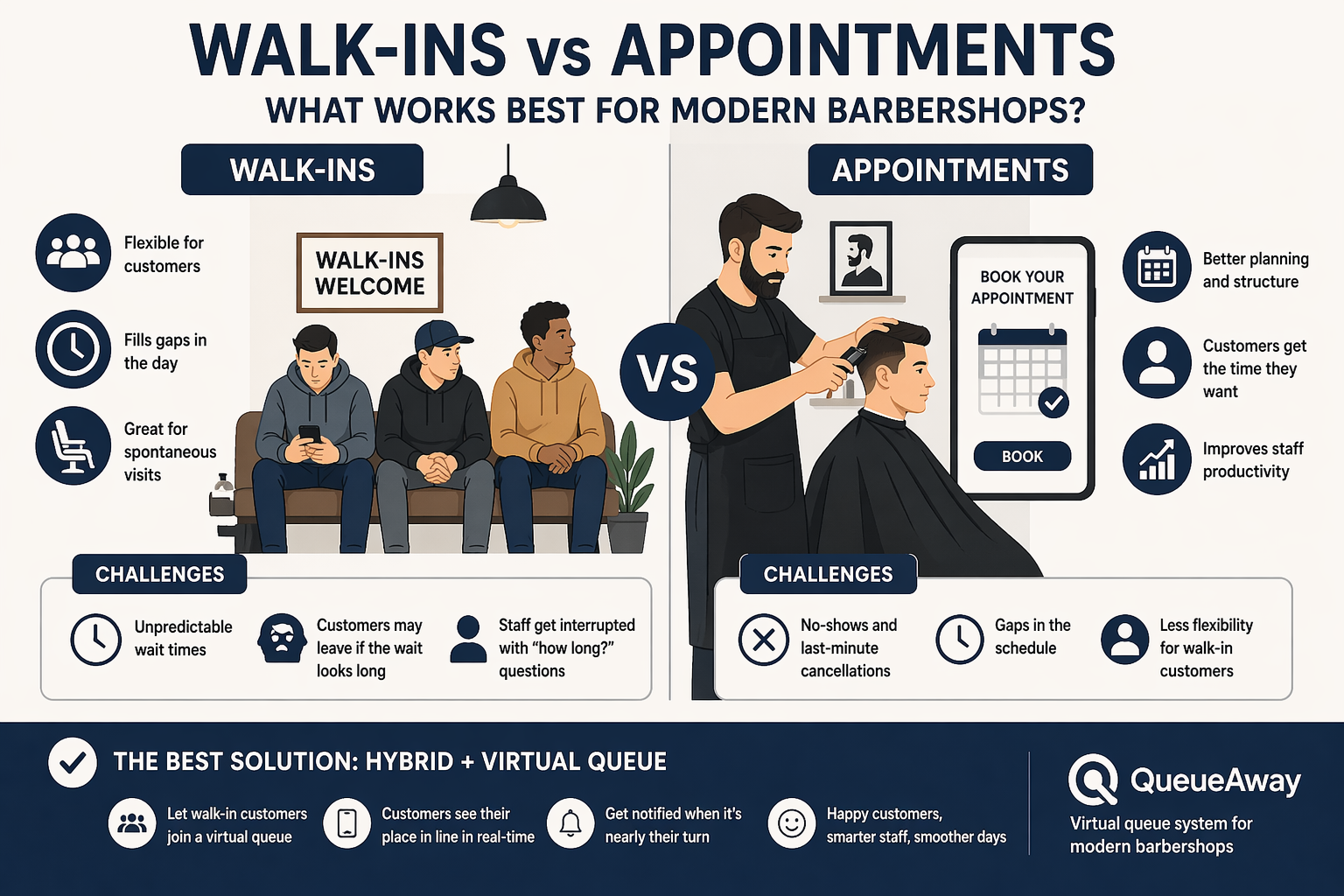
Most barbershops don't have to choose between walk-ins and appointments — the best ones run both. This guide covers the real challenges of managing walk-in flow, the pros and cons of each model, and the marketing trends shaping how walk-in barbershops operate in 2026.
Why walk-ins are hard to manage in busy barbershops
If you run a busy barbershop, you already know the pattern. Friday afternoon. Saturday morning. School holidays. Payday weekends. The shop fills up fast. Chairs are full. People are standing. New walk-ins look around — and sometimes quietly leave. Not because the haircut isn't good, but because the waiting experience feels uncertain.
Barbershops are different from most retail businesses. They have predictable peak times, limited physical space, variable haircut durations, and customers making stay-or-leave decisions within 30 seconds. Unlike restaurants, you don't take names formally. Unlike salons, you often don't run full appointments. So queues form informally — and informal queues create problems:
- Customers don't know how long they'll wait
- Staff constantly answer "How long roughly?"
- People walk out without saying anything
- Regulars feel overlooked
- The shop looks overcrowded even when wait times are manageable
That uncertainty costs money.
The hidden cost of poor walk-in management
Most shops don't realise they're leaking revenue through poor queue visibility. Shops that introduce a structured queue management system for barbershops consistently see fewer walk-outs and smoother peak-hour flow.
Walk-ins vs appointments: what actually works best?
The classic barbershop was built around walk-ins. Customers turned up, took a seat, waited their turn. But modern customer expectations have changed — many clients now expect convenience, visibility and control over their time.
The case for walk-ins
Walk-ins are part of traditional barbershop culture. They make a shop feel open, accessible and spontaneous. For customers who need a quick trim, are passing by, or don't want to plan ahead, walk-ins are still valuable. They can also fill quiet gaps in the day — if a barber has space between bookings, a walk-in customer turns dead time into revenue. The problem is that walk-ins become difficult when the shop gets busy and customers can't tell how long the wait will be.
The case for appointments
Appointments give barbershops more structure. They help staff plan the day, reduce uncertainty, and make it easier for customers to secure a specific time. Mangomint reported that 77.49% of barbershop appointments were booked online in recent years, compared with 22.51% through walk-ins or phone. But appointments are not perfect — customers can run late, no-show, or leave awkward gaps in the diary. A fully appointment-only model can also turn away valuable walk-in trade.
Why the hybrid model works best
A hybrid model gives a barbershop the best of both worlds. Regular clients can book ahead, while walk-in customers can still join the queue when space is available. Research from Zenoti found that 7 in 10 barbershop customers walk in without an appointment at least sometimes. Walk-ins remain a core part of barbershop customer behaviour — the goal is managing them properly, not eliminating them.
| Model | Best for | Main risk |
|---|---|---|
| Walk-ins only | Flexible, spontaneous customers | Long visible waits, lost customers |
| Appointments only | Planned visits and repeat clients | No-shows, gaps, reduced flexibility |
| Hybrid + digital queue | Busy modern barbershops | Needs a clear system to manage flow |
Traditional walk-in systems — and why they break at scale
The whiteboard list — simple and visible, but gives no time estimates, still requires customers to stay, and looks chaotic during peak times.
The "just wait there" system — no list, no board, just mental tracking. Works when 2–3 people are waiting. Breaks completely when 8+ people are in the shop and new walk-ins arrive in clusters.
Going appointment-only — solves waiting but kills spontaneous trade, turns away impulse walk-ins, and adds admin. For many barbershops, walk-ins are still the lifeblood. The real solution isn't removing walk-ins — it's managing them properly.
The modern solution: digital queue management
Instead of making customers physically stand in line, modern shops use a digital queue management system built for barbershops. Here's how it works:
- Customer walks in or arrives nearby
- Joins the queue via tablet, QR code, or a link on their phone
- Sees their estimated wait time and live position
- Leaves to grab a coffee or run an errand if they want
- Gets notified when they're near the top
The shop feels calm. The queue is organised. Customers feel in control. And you don't lose walk-ins just because the shop looks full.
What to look for in a digital queue for barbershops
Not all queue systems are built for walk-in flow. Look for something that is designed for walk-ins rather than calendar booking, shows realistic wait estimates, works on mobile without requiring an app download, is simple for staff to manage mid-cut, and doesn't disrupt your existing workflow.
Walk-in barbershop marketing trends in 2026
The barbershop industry is changing faster in 2026 than it has in the past decade. Walk-in shops face new pressure from appointment-only studios, shifting client expectations around wait times, and social media algorithms that favour video. Here's what's actually moving the needle this year. For full industry context, see our barbershop statistics roundup.
-
1Transparent wait times are now a marketing tool
The biggest shift in 2026 is that clients expect to know how long they'll wait before they step through the door. Shops that surface live wait times — on Google, their website, or a screen in the window — are seeing measurably higher walk-in conversion. Uncertainty kills footfall. Transparency builds it.
-
2Local SEO has become the frontline for walk-in shops
"Barber near me" searches have overtaken branded searches in most UK cities. Walk-in shops that keep their Google Business Profile accurate — real photos, current hours, weekly posts, and replied-to reviews — consistently outrank competitors with better websites but weaker local signals. It costs nothing and compounds over time.
-
3Short-form video is replacing word of mouth
TikTok and Instagram Reels have become the new barbershop window display. A 15-second before-and-after clip, posted with local hashtags, now reaches more potential clients than a flyer drop or paid post. The barbers winning on social in 2026 post consistently — not perfectly. Two clips a week beats one polished monthly shoot every time.
-
4Slow-hour deals are replacing blanket discounting
Blanket discounts train clients to wait for a deal. Smarter walk-in shops are running time-specific offers — a free hot towel or line-up during weekday mornings only — to move idle chair time without eroding peak-hour pricing. Promote it on your Google listing and a sign in the window.
-
5Retention is cheaper than acquisition in a tighter market
With more barbershops opening in cities across the UK, US, and beyond, client acquisition costs are rising everywhere. The shops growing most profitably are doubling down on keeping existing clients — through text reminders, simple referral schemes, and making every visit feel personal. A client who returns every three weeks is worth more than three one-time visitors.
-
6Multi-location shops need centralised client flow data
For barbershops running two or more chairs or sites, visibility across locations has become a real competitive edge. Knowing which chair is backed up, which location is quiet, and where walk-in drop-off happens — and being able to act in real time — is no longer a luxury. It's the difference between growing and plateauing.
How to transition to a digital queue without disrupting your shop
Switching doesn't have to be disruptive. Most shops follow this pattern:
- Introduce the tablet or QR code joining point at the door or front desk
- Keep your existing flow running in parallel for the first week
- Train staff to explain it in one sentence: "Just scan here and you'll get a text when we're ready for you"
- Add a small sign at the entrance explaining how to join
- Monitor walk-out reduction over the following two to four weeks
Within a month, it becomes the new normal. For a deeper look at how queue management affects barbershop operations, including staff workflow and peak-hour planning, see our operations guide.
Frequently asked questions
For most clients, walking in still offers the most flexibility — no commitment, no scheduling, just turn up and get a cut. The downside is uncertainty around wait times. The best walk-in barbershops in 2026 solve this with a digital queue system that lets clients see and join the queue remotely, combining the freedom of walking in with the transparency of knowing how long they'll wait.
UK barbershops use a range of systems depending on their model. Appointment-only shops often use tools like Fresha or Treatwell. Walk-in barbershops increasingly use dedicated queue management software like QueueAway, which is built specifically for shops that want to manage client flow digitally without forcing customers into a booking system.
Barbershops manage walk-ins efficiently by creating a clear and structured waiting process — visible wait times, realistic estimates, and increasingly a digital queue that lets customers join remotely and receive updates. The key is reducing uncertainty: when customers understand how long they'll wait, they're far less likely to leave.
Customers rarely walk out simply because a shop is busy. They leave when the wait feels unclear or unpredictable. A customer who can't tell whether the wait is 10 minutes or 45 minutes is more likely to try somewhere else — even if the actual wait would have been fine.
Yes. Walk-ins remain valuable for passing trade, regulars, and last-minute customers. The key is managing them clearly so customers understand how long they may need to wait — and feel comfortable enough to stay. See our full comparison of digital queues vs booking apps for more on choosing the right system.
By using a digital queue or virtual waiting room for barbershops. This lets walk-in customers join the queue, see their position, and receive updates, while appointment customers remain scheduled separately. The two streams run in parallel without creating confusion at the desk.
The best queue system for a barbershop supports both walk-ins and appointments, gives customers wait-time visibility, and lets staff manage customer flow from a phone, tablet, or desktop without extra hardware or a complicated booking calendar. See our roundup of the best barbershop queue apps for a full comparison.
Stop losing walk-ins to uncertainty
QueueAway helps walk-in barbershops manage client flow, reduce walk-outs, and give customers the wait-time visibility they expect — without switching to an appointments model.
See how QueueAway works →