

Average Wait Times in US Retail (2026): Data, Trends & What It Means for Businesses
Introduction: Why Wait Times Matter More Than Ever in 2026
In 2026, wait time is one of the biggest drivers of customer behaviour in US retail. With rising expectations, mobile-first consumers, and instant gratification culture, even a few extra minutes in line can mean the difference between a sale… and a walkout. As wait times continue to impact customer satisfaction across the US, many retailers are now turning to a queue management system in the US to reduce queues and improve in-store experiences.
And the data is clear:
Customers now expect service in under 5–7 minutes
Most retail wait times exceed this threshold
Businesses are losing billions annually due to queues
This report breaks down average wait times in US retail, how long customers are willing to wait, and what smart retailers are doing to fix it.
Average Wait Time in US Retail (2026)
The latest 2026 data shows:
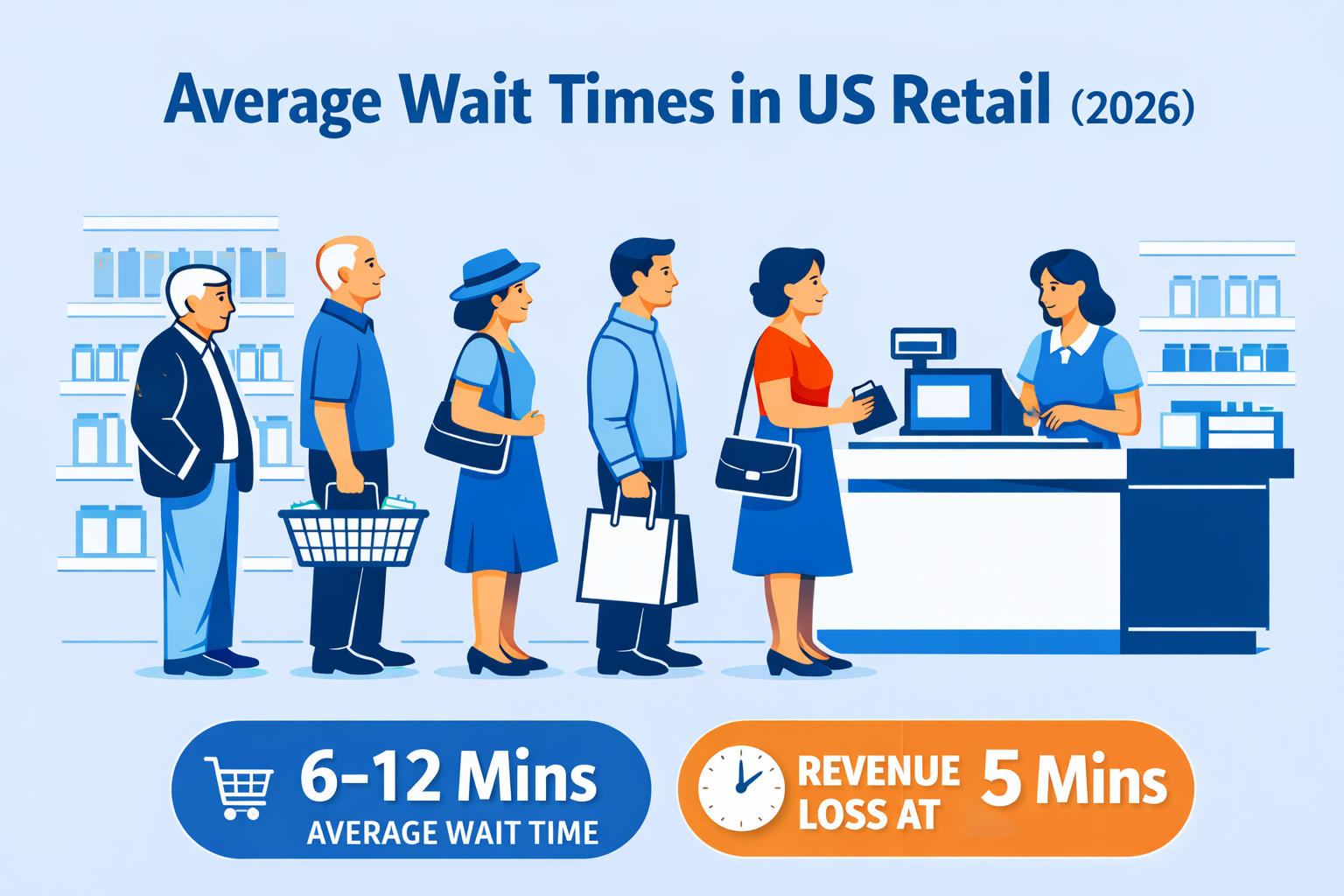
Average retail wait time: 6–12 minutes
Target best practice: under 4 minutes
Key Insight:
The average wait is now longer than customer tolerance
This gap is where revenue is lost.
How Long Customers Will Actually Wait
Customer patience has dropped significantly over the past decade.
2026 Benchmarks:
3 minutes: 21% already frustrated
5 minutes: 58% consider leaving
8 minutes: average abandonment threshold
10 minutes: up to 82% will walk away
What this means:
You don’t have a queue problem at 10 minutes
You have a revenue loss problem at 5 minutes
Queue Abandonment in US Retail
Queue abandonment is one of the most important retail metrics in 2026.
Typical abandonment rates:
Retail stores: ~14%+
Quick-service retail: ~21%
Peak periods: significantly higher
And behaviour is worsening:
75% of customers leave if waits exceed 10 minutes
89% are less likely to return after a bad queue experience
This isn’t just lost sales
It’s lost lifetime customers
The Cost of Retail Waiting Times in the US
Poor queue management is now a multi-billion dollar problem.
Estimated losses: $75–130 billion annually in the US
These losses come from:
Abandoned baskets
Reduced repeat visits
Negative reviews
Lower staff efficiency
Queue friction is now a top-line revenue issue, not just an operational one.
The Psychology of Waiting (Why It Feels Worse Than It Is)
Here’s the interesting part:
Waits feel 36% longer when customers lack visibility
That means:
A 5-minute unknown wait feels like 7 minutes
A 5-minute tracked wait feels manageable
Visibility often matters more than speed. These rising wait times highlight why understanding what is a queue management system is becoming increasingly important for retailers looking to stay competitive.
Sector
Fast retail / checkout
General retail
Salons / service retail
Restaurants (walk-in)
Average Wait Time
3–5 mins
8–12 mins
10–20 mins
15–25 mins
Customer Tolerance
Very low
Moderate
Higher
Higher
The key takeaway:
Retail has the lowest tolerance of all service sectors
How Top Retailers Are Reducing Wait Times
Leading US retailers are not just adding staff — they’re redesigning queues.
Proven strategies:
1. Virtual Queues
Customers join via QR code
Wait remotely instead of standing in line
2. Real-Time Queue Visibility
Live position updates reduce frustration
Improves perceived wait time dramatically
3. Smarter Staffing
Data-driven scheduling based on peak demand
4. Self-Service & Mobile Checkout
Reduces pressure on tills
5. Queue Management Systems
Reduce wait times by up to 40–70%
The shift is clear:
From physical queues → digital customer flow
What “Good” Looks Like in 2026
If you’re benchmarking your retail business:
Ideal wait time: < 4 minutes
Acceptable: 5–7 minutes
Risk zone: 8+ minutes
Anything above this:
Impacts conversion
Damages customer experience
Reduces repeat visits
The Future of Retail Waiting
Retail is evolving fast:
43% of retail chains now use mobile queue systems
Digital queues are becoming standard
Physical lines are gradually disappearing
The winning stores in 2026:
Remove visible queues
Replace them with controlled, trackable customer flow
Final Takeaways
Average US retail wait times sit at 6–12 minutes
Customers expect under 5 minutes
More than half leave after 5 minutes
Poor queues cost the US economy $75–130 billion annually
The Bottom Line:
Queue management is no longer optional
It’s a core revenue driver. Modern retailers are adopting digital tools like queue management systems for businesses to control customer flow, reduce congestion, and improve service speed.
FAQ
What is the average wait time in US retail?
The average wait time in US retail is between 6 and 12 minutes, depending on store type and peak demand.
How long will customers wait in a retail queue?
Most customers will wait 3–8 minutes, with over half leaving after 5 minutes.
How much money do queues cost US retailers?
Queues cost US businesses between $75 billion and $130 billion annually due to lost sales and inefficiencies.
What is a good retail wait time?
A good retail wait time in 2026 is under 4 minutes, with anything over 7 minutes considered high-risk.