

How Long Americans Will Wait in Line (2026)
Introduction: The Hidden Cost of Waiting
In the United States, waiting in line isn’t just an inconvenience—it’s a measurable business risk.
Whether it’s retail checkout lines, restaurant waitlists, healthcare reception queues, or service counters, customer patience has limits. And when those limits are exceeded, businesses don’t just lose time—they lose revenue, loyalty, and long-term growth. This behaviour highlights why businesses are increasingly turning to a queue management system in the US to reduce perceived wait times and improve customer experience.
So the real question is:
How long will Americans actually wait in line before they leave?
This article breaks down the latest data, behavioral insights, and real-world statistics from 2026—so you can understand exactly where that tipping point lies.
The Average Time Americans Are Willing to Wait
Research across retail, hospitality, and service industries shows a clear pattern:
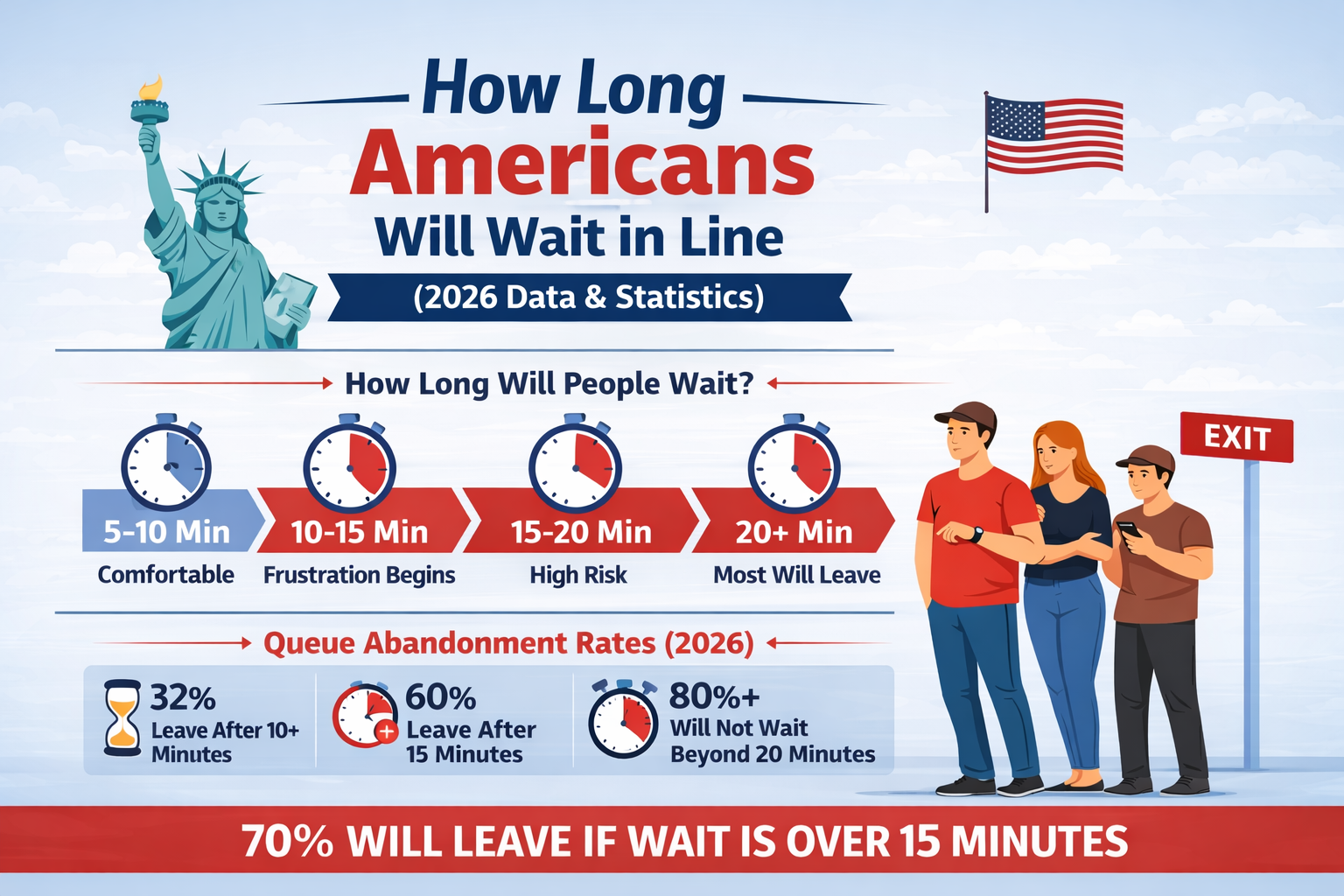
5–10 minutes → Comfortable wait range
10–15 minutes → Frustration begins
15–20 minutes → High abandonment risk
20+ minutes → Majority will leave
Key Statistic:
70% of Americans say they would leave a business if the wait exceeds 15 minutes
This is the critical threshold—and one of the most important numbers for any business managing foot traffic.
When Do Customers Walk Away?
Queue Abandonment Rates (USA 2026)
32% leave after waiting more than 10 minutes
60% leave after 15 minutes
80%+ will not wait beyond 20 minutes
This behavior is known as queue abandonment—and it’s one of the biggest hidden revenue leaks in US businesses. Businesses that want to stay competitive must look beyond traditional queues and adopt systems designed to reduce waiting and improve flow — this is exactly where queue management systems for businesses make a measurable difference.
Why It Matters:
Every customer who leaves represents:
Lost immediate revenue
Reduced lifetime value
Potential negative reviews
The Psychology Behind Waiting
The reality is:
Perceived wait time matters more than actual wait time
Customers are far more tolerant when they:
Know their position in line
Receive updates
Feel progress is being made
And far less tolerant when they:
Feel ignored
Can’t see the queue moving
Have no estimate of wait time
This is why unmanaged queues feel longer—even when they aren’t. Retail environments show even shorter patience levels, as highlighted in recent US wait time data.
The Business Impact of Long Wait Times
Long queues don’t just frustrate customers—they directly impact performance.
US Business Impact Data:
Businesses lose 20–30% of potential revenue due to long waits
73% of customers say wait time affects their decision to return
Negative reviews increase significantly once waits exceed 15 minutes
In retail alone, long checkout queues are one of the top causes of cart abandonment in physical stores.
Industry Breakdown: Where Waiting Matters Most
Retail
Peak hours see wait times exceed 20 minutes
Customers expect under 10 minutes
Related:
Average Wait Times in US Retail (2026)
Restaurants & Hospitality
Customers tolerate slightly longer waits
But only if expectations are set clearly
Related:
Restaurant Waitlist Management Systems
Healthcare
Patients expect transparency over speed
Uncertainty causes the most frustration
Salons & Barbershops
Walk-in customers are highly sensitive to wait visibility
Poor queue management leads to lost repeat business
How Businesses Reduce Wait Time Frustration
Modern businesses aren’t necessarily making queues shorter…
They’re making them feel shorter.
The Shift: Physical Queue → Virtual Queue
Instead of standing in line, customers can:
Join a queue via QR code
Track their position in real time
Leave and return when ready
Receive notifications when it’s their turn
This transforms waiting from a negative experience → controlled experience
Real-World Solution: Queue Management Systems
A queue management system allows businesses to:
Reduce perceived wait times by up to 50%
Cut physical crowding significantly
Improve customer satisfaction
Increase throughput and efficiency
Learn more:
Queue Management System Explained
Key Takeaways (2026 Data)
The 15-minute mark is the tipping point
Most customers will leave before 20 minutes
Lack of visibility increases frustration
Queue abandonment directly impacts revenue
Virtual queues dramatically improve experience
Final Thought: Waiting Is No Longer Passive
Customers today don’t accept uncertainty.
They expect:
Control
Visibility
Convenience
Businesses that still rely on traditional queues are operating with a major disadvantage.
Those that adapt?
They turn waiting into a competitive advantage.
Frequently Asked Questions About Waiting in Line (USA)
How long will Americans typically wait in line?
Most Americans are willing to wait between 5 and 15 minutes. After 15 minutes, frustration increases significantly, and many customers begin to consider leaving.
What is the maximum time customers will wait before leaving?
Research shows that around 60% of customers will leave after 15 minutes, and more than 80% will not wait longer than 20 minutes.
Why do customers leave queues?
Customers abandon queues due to:
Long wait times
Lack of updates or visibility
Uncertainty about how long the wait will be
Poor queue organisation
What is queue abandonment?
Queue abandonment refers to customers who leave before being served due to long or unclear wait times. It’s a major cause of lost revenue for businesses.
Do customers mind waiting if they know how long it will take?
Customers are far more patient when they:
Know their position in line
Receive real-time updates
Have an estimated wait time
This is known as reducing perceived wait time.
How can businesses reduce waiting frustration?
Businesses can improve the experience by using a queue management system or virtual queue app that allows customers to:
Join remotely
Track their place in line
Receive notifications
What industries are most affected by long queues?
The industries most impacted include:
Retail
Restaurants and hospitality
Healthcare
Salons and barbershops
These sectors rely heavily on managing walk-in traffic efficiently.