

Queue Management Statistics USA: Key Waiting Line & Customer Wait Time Data
Queue Management Statistics USA
Waiting is one of the most common friction points in customer experience. In the United States, long lines, unclear wait times, crowded waiting areas, and inefficient check-in processes affect retail stores, healthcare providers, restaurants, salons, government offices, and service businesses every day. These trends highlight why businesses across the country are adopting a queue management system in the US to better handle customer flow and rising expectations.
That is why queue management has become more than an operations issue. It is now a customer experience issue, a staffing issue, and in many sectors, a revenue issue.
This page brings together key queue management statistics in the USA to show how customer expectations, mobile behavior, retail activity, healthcare demand, and restaurant waitlist trends all point in the same direction: businesses need faster, clearer, more flexible ways to manage waiting. U.S. adults now have extremely high smartphone adoption, while U.S. retail sales and e-commerce volumes remain enormous, creating a strong case for mobile-friendly queue systems and virtual waiting experiences.
Key U.S. Queue Management Statistics
Here are some of the most important queue management statistics for the USA:
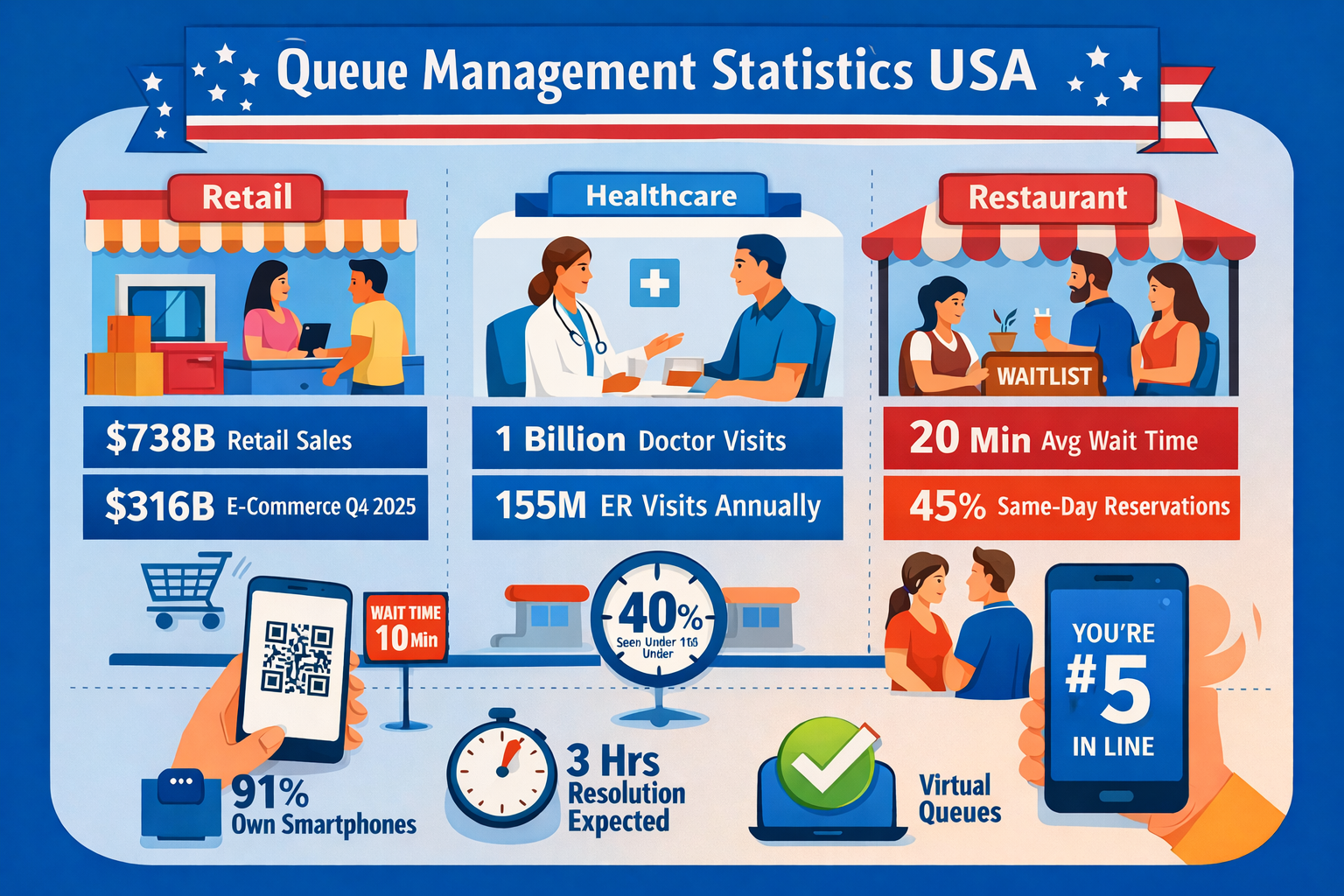
91% of U.S. adults own a smartphone, making mobile-first queue tools practical for the vast majority of customers.
U.S. retail and food services sales reached $738.4 billion in February 2026, up 3.7% year over year, showing the scale of in-person and omnichannel consumer activity businesses must handle.
U.S. retail e-commerce sales were $316.1 billion in Q4 2025, while total retail sales were $1.9005 trillion in the same quarter, showing that physical and digital customer journeys now coexist at massive scale.
The U.S. records 1.0 billion physician office visits annually, showing how important efficient patient flow and check-in systems are in healthcare settings.
The U.S. records 155.4 million emergency department visits annually, and only 40.6% of patients are seen in fewer than 15 minutes, highlighting how critical wait visibility and flow management are in healthcare environments.
Restaurant guests on a waitlist wait around 20 minutes on average, while 45% of reservations in Q3 2024 were same-day, putting more pressure on hosts and front-of-house teams to manage demand in real time.
More than half of CRM leaders say customers expect problem resolution in three hours or less, showing how speed expectations are rising well beyond traditional in-person service environments.
Retail Queue Statistics in the USA
Retail remains one of the strongest use cases for queue management systems in the U.S. The size of the market alone makes queue performance important. U.S. retail and food services sales reached $738.4 billion in February 2026, up 0.6% month over month and 3.7% year over year. In Q4 2025, total retail sales reached $1.9005 trillion, with $316.1 billion of that coming from e-commerce.
That matters because modern retail is no longer purely in-store or purely online. Customers often browse online, visit stores in person, compare wait times, and expect fast service regardless of channel. Even mall traffic was reported as rising during 2025, with Capital One Shopping data cited by NRF showing indoor mall foot traffic up 1.8% year over year in the first half of 2025 and visit duration up 3.3%. More physical traffic means more demand on checkout, service desks, fitting rooms, click-and-collect counters, and event-based queues.
For queue management, the retail takeaway is simple: when transaction volumes are high and customer patience is limited, businesses need a better way to organize flow, communicate wait times, and prevent visible lines from becoming a conversion problem. A digital queue or virtual waiting room gives retailers a way to move part of that waiting experience onto the customer’s phone instead of forcing everyone to stand in one physical line. The feasibility of that approach is strengthened by the fact that 91% of U.S. adults own a smartphone. With mobile usage this high, understanding what is a queue management system and how it enables digital queues is essential for modern US businesses. At this scale, retailers are increasingly relying on queue management systems for businesses to reduce congestion and improve conversion rates.
Healthcare Queue Statistics in the USA
Healthcare is one of the clearest examples of why queue management matters. The U.S. records 1.0 billion physician office visits annually, along with 155.4 million emergency department visits. That is a huge amount of patient flow to manage across check-in desks, reception areas, triage, waiting rooms, and treatment pathways.
CDC FastStats also shows that only 40.6% of emergency department visits result in the patient being seen in fewer than 15 minutes. That means most emergency patients wait longer than 15 minutes before being seen, even before considering total length of stay. In environments where stress is high and communication matters, unclear waiting is often worse than waiting itself.
For outpatient clinics, GP-style settings, urgent care, and specialist practices, queue management systems can help by:
spreading arrivals more evenly
reducing front-desk congestion
letting patients join a queue digitally
showing live position or estimated wait
allowing staff to call patients forward at the right moment
In healthcare, queue systems are not just about convenience. They can help improve privacy, reduce crowded reception areas, and create a calmer experience for both patients and staff. In high-volume environments like this, queue management systems are becoming essential infrastructure rather than optional tools.
Restaurant Waitlist and Queue Statistics in the USA
Restaurants are another major U.S. use case for queue management, especially where walk-ins and peak demand overlap. Toast reports that guests placed on a waitlist stick around for 20 minutes on average. It also reports that 45% of reservations in Q3 2024 were made the same day, while 17% were canceled, down from 19% the previous year.
Those numbers show how dynamic restaurant demand has become. Restaurants are increasingly dealing with short booking windows, last-minute changes, fluctuating party flows, and a need to fill tables efficiently without creating a poor guest experience.
That is where a digital waitlist or virtual queue helps. Instead of having guests physically stand at the host desk or repeatedly ask how long it will be, restaurants can let them join a queue remotely, see their place, and receive updates on their phone. That reduces pressure on front-of-house staff and can make wait time feel more manageable.
Why These U.S. Queue Statistics Matter
Taken together, these U.S. queue management statistics show a few clear themes.
First, customer expectations are accelerating. Whether it is a shopper, diner, patient, or visitor, people increasingly expect faster service and better communication. HubSpot’s 2024 State of Service report found that more than half of CRM leaders say their customers expect issues to be resolved in three hours or less. That expectation for speed carries into physical environments too.
Second, mobile access is no longer a barrier for most U.S. audiences. With smartphone ownership at 91% of adults, businesses can confidently use QR-code joins, browser-based wait pages, and mobile notifications as part of the queue experience.
Third, the scale of the market makes small improvements meaningful. When retail sales, physician visits, and restaurant traffic are all this large, even modest reductions in waiting friction can improve throughput, staff efficiency, and customer satisfaction at scale.
How Businesses Use Queue Management Systems to Reduce Wait Times
Businesses across the USA use queue management systems to:
replace physical lines with digital joining
show live queue position or estimated wait time
reduce overcrowding in waiting areas
spread arrivals more evenly across the day
improve staff coordination
collect data on peak times and service bottlenecks
In practice, that can mean:
a retail store using a QR-code queue during launches or busy weekends
a healthcare clinic reducing reception congestion
a restaurant managing walk-ins with a live waitlist
a barbershop or salon smoothing out busy walk-in periods
an event venue creating a branded virtual waiting room
The statistics do not just show that Americans are waiting. They show that the operating environment now favors businesses that make waiting feel clearer, shorter, and better managed. Taken together, these statistics clearly show why businesses are investing in smarter ways to manage waiting — making queue management solutions a key part of modern service operations.
FAQs
What are the most important queue management statistics in the USA?
Some of the most useful U.S. statistics include 91% smartphone ownership among adults, $738.4 billion in February 2026 retail and food services sales, 1.0 billion physician office visits annually, 155.4 million emergency department visits, and 20-minute average restaurant waitlist times.
Why is queue management important in the USA?
Queue management matters because U.S. businesses serve customers at very high volume across retail, healthcare, restaurants, and service sectors. Long waits, poor communication, and crowded waiting areas can hurt customer satisfaction, staff productivity, and revenue.
Are virtual queues realistic for U.S. customers?
Yes. Smartphone ownership is now extremely high in the U.S., with 91% of adults owning one, which makes QR-code and browser-based queue systems realistic for most businesses and customers.
Which U.S. industries benefit most from queue management systems?
Retail, healthcare, restaurants, salons, barbershops, events, public services, and hospitality businesses can all benefit, especially where walk-ins, peak demand, or waiting rooms are common. The data is particularly strong for retail, healthcare, and restaurant use cases.