

How Long Guests Will Wait in Hospitality (And When They Leave) [2026 Data]
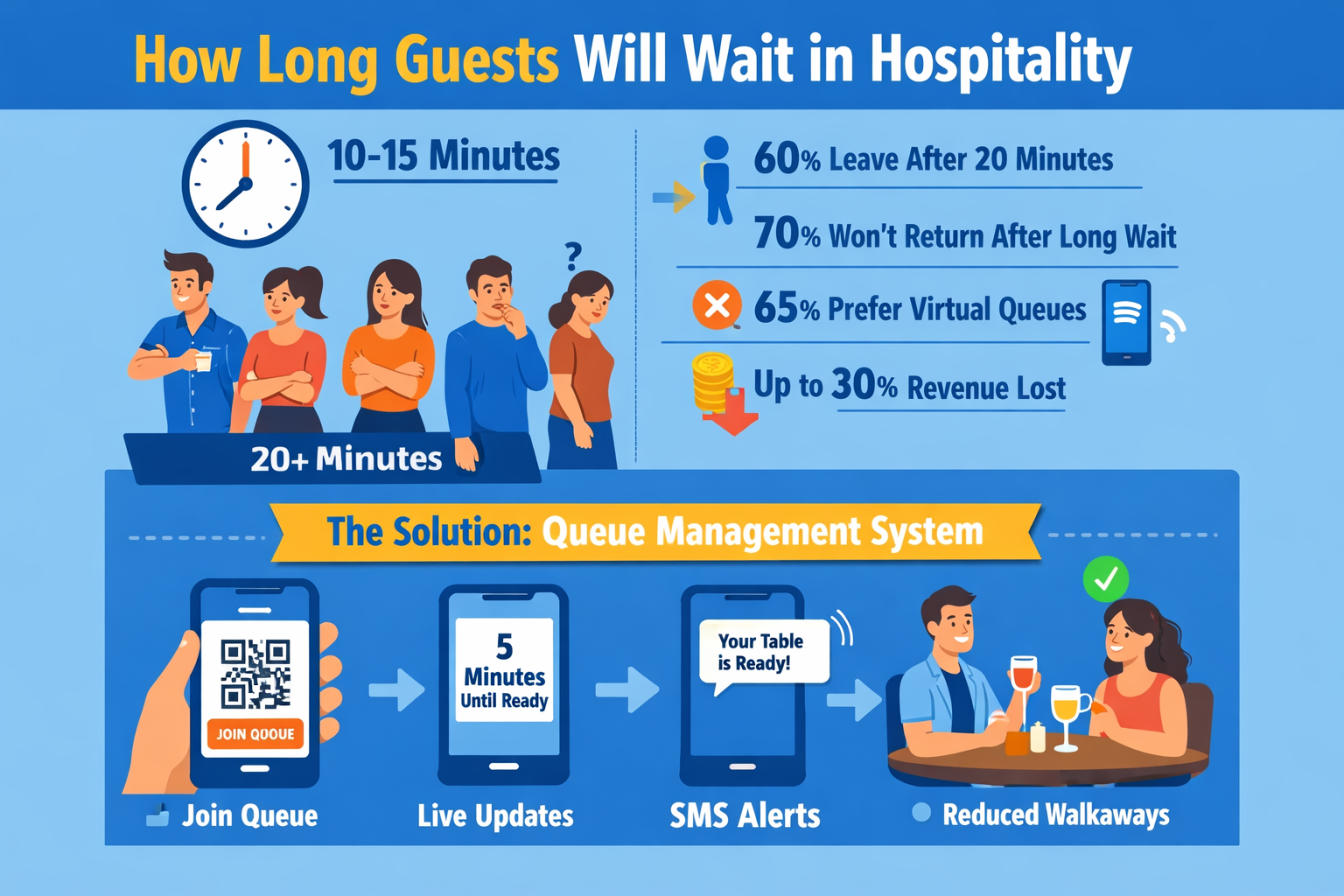
Waiting is one of the biggest silent killers of revenue in hospitality.
Whether it’s a busy restaurant, a packed bar, or a hotel check-in desk, long or uncertain wait times don’t just frustrate guests — they drive them away.
In 2026, guest expectations are higher than ever. People are no longer willing to stand in crowded spaces with no visibility, no updates, and no control. A modern hospitality queue management system allows venues to remove physical lines and give guests real-time updates on their wait.
Understanding queue management in hospitality is essential for reducing wait times and improving guest experience
This raises a critical question:
How long will guests actually wait before they leave?
Key Hospitality Waiting Statistics (2026)
Metric
Average acceptable wait (restaurant)
Guests who leave after 20 minutes
Guests who won’t return after long wait
Guests preferring virtual queues
Revenue lost due to walkaways
Statistic
10–15 minutes
60%
70%
65%
Up to 30%
he “Patience Curve” in Hospitality
Guest tolerance isn’t linear — it drops sharply after a certain point. Businesses using a queue management system see significant reductions in walkaways and improved guest satisfaction.
Typical behaviour:
0–5 minutes → No issue
5–10 minutes → Mild frustration
10–15 minutes → Doubt begins
15–20 minutes → Decision point
20+ minutes → Walkaway risk spikes
The key insight:
It’s not just the wait — it’s the uncertainty of the wait. Once wait times exceed 15 minutes, businesses must actively work on reducing wait times in hospitality to prevent significant guest drop-off.
Why Guests Leave (It’s Not Just Time)
Guests rarely leave because of time alone.
They leave because of:
Lack of visibility
No idea how long the wait is
No control
Forced to stand in one place
Poor communication
No updates from staff
Environment discomfort
Crowded, noisy, stressful
The Psychology of Waiting in Hospitality
Research consistently shows:
Unoccupied time feels longer than occupied time
Uncertain waits feel longer than known waits
Unfair waits feel longest of all
This is why a 10-minute transparent wait feels shorter than a 5-minute unknown wait.
The Real Cost of Walkaways
Let’s break it down.
Example:
50 guests per day walk away
Average spend = £25
Lost daily revenue = £1,250
Monthly loss = £37,500
And that’s before factoring in:
negative reviews
lost lifetime value
brand damage
How Hospitality Businesses Reduce Wait Abandonment
The most effective venues don’t just reduce wait times…
They change how waiting works entirely
1. Set Clear Expectations
Guests are far more patient when they know:
how long they’ll wait
where they are in the queue
2. Remove Physical Queues
Standing = frustration
Allow guests to:
sit
relax
order drinks
explore nearby areas
3. Provide Real-Time Updates
Simple updates dramatically reduce anxiety:
“You’re next”
“5 minutes remaining”
“Table being prepared”
4. Introduce a Hospitality Queue Management System
This is where modern venues gain a serious advantage.
A hospitality queue management system allows guests to:
join a queue via QR code
track their position live
receive SMS notifications
arrive exactly when needed
Real Impact of Virtual Queues in Hospitality
Businesses using queue systems report:
up to 30% reduction in walkaways
increased guest satisfaction
higher spend per visit
smoother staff operations
Why This Matters More in 2026
Guest expectations have changed permanently.
People expect:
digital convenience
transparency
control over their time
If your venue still relies on physical queues, you’re competing at a disadvantage. Similar behaviour is seen in retail, where research into how long customers will wait in retail stores shows abandonment increases rapidly after 15 minutes.
Key Takeaways
Most guests won’t wait more than 15–20 minutes
Uncertainty is worse than the wait itself
Walkaways can cost up to 30% of revenue
Virtual queues dramatically improve retention
Queue management is now a competitive advantage
Businesses that implement a queue management system not only reduce walkaways but also increase revenue through better guest flow and higher table turnover.
FAQ SECTION
Q1: How long will customers wait in a restaurant before leaving?
Most customers will wait between 10–15 minutes. After 20 minutes, the majority are likely to leave.
Q2: Why do guests leave queues in hospitality?
Guests leave due to uncertainty, lack of updates, and poor queue visibility rather than just long wait times.
Q3: What is queue abandonment in hospitality?
Queue abandonment refers to guests leaving before being served due to long or unclear wait times.
Q4: How can restaurants reduce wait times?
Restaurants can reduce perceived wait times by using digital queues, providing updates, and improving communication.
Q5: What is a hospitality queue management system?
A hospitality queue management system allows guests to join and track queues digitally, reducing physical lines and improving experience.