

Hospitality Queue Statistics (2026): Wait Times, Customer Behaviour & Revenue Impact
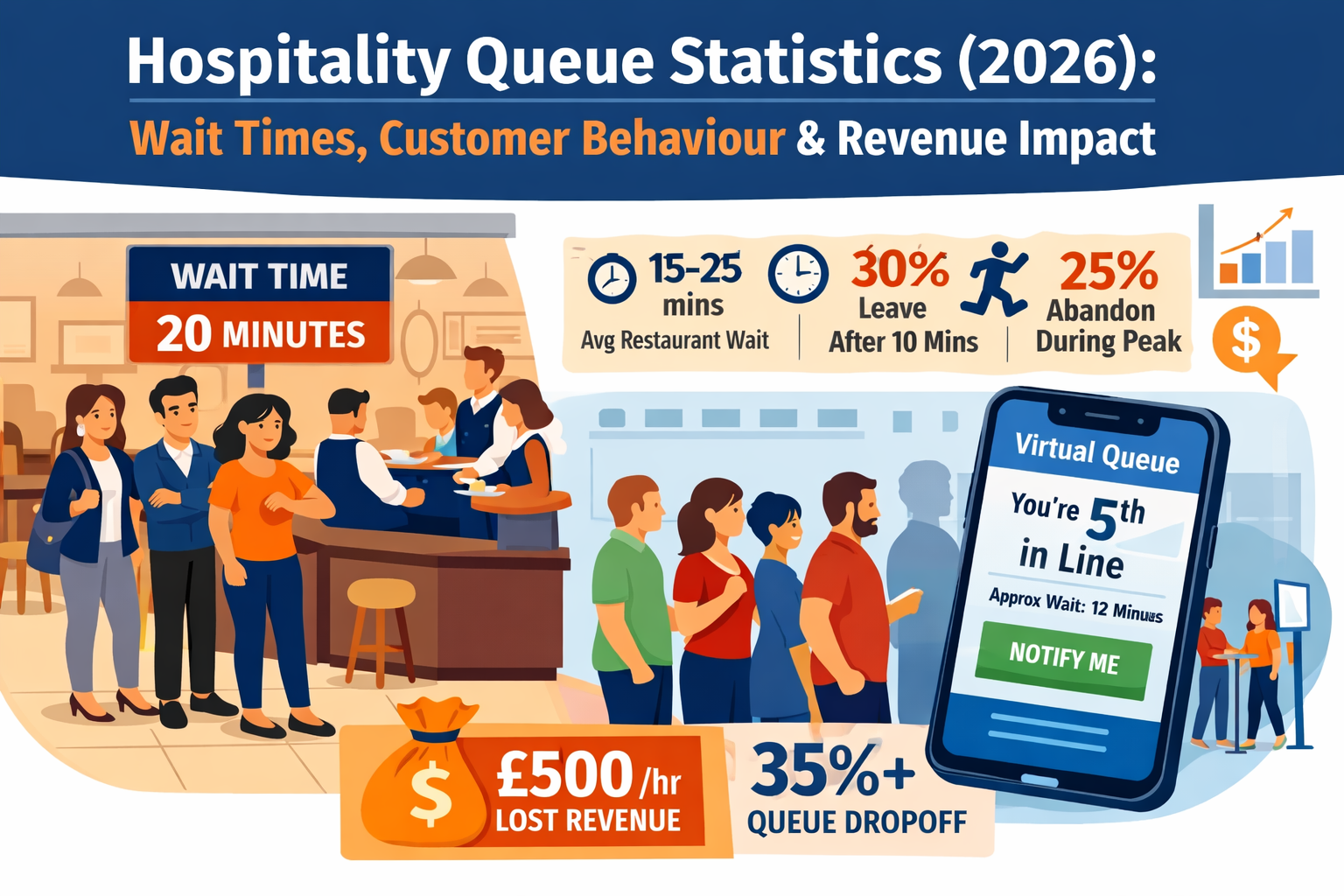
Waiting is costing hospitality businesses more than they realise
Queues are one of the most underestimated revenue leaks in hospitality.
From restaurants and bars to hotels and event venues, waiting impacts:
Customer satisfaction
Staff efficiency
Table turnover
Revenue
In this 2026 hospitality study, we break down the latest data on:
Average wait times
Customer tolerance
Queue abandonment rates
The financial impact of delays
Average Wait Times in Hospitality
Industry data shows that waiting is a daily reality across hospitality environments.
Restaurants (peak hours): 15–25 minutes average wait time
Bars (busy periods): 10–18 minutes
Hotel check-in: 5–12 minutes average
Event venues: 20–40 minutes entry queues
According to industry research and operational benchmarks across UK and US venues, wait times increase significantly during peak periods, especially weekends and evenings.
Insight:
Even moderate delays can quickly build into customer frustration, particularly when queues appear unstructured or unpredictable.
Many businesses are now investing in a queue management system for hospitality to better manage peak demand, reduce congestion, and improve customer flow
How Long Customers Will Wait
Customer patience is far shorter than most businesses expect.
Around 50% of customers won’t wait longer than 15 minutes
Nearly 30% will leave after just 10 minutes
Only 10–15% are willing to wait beyond 20 minutes
Multiple hospitality and retail behaviour studies show that tolerance drops sharply once customers feel a lack of control or visibility. Understanding exactly how long customers will wait in hospitality is critical for reducing walkaways and improving service efficiency.
Critical takeaway:
Your effective service window is often under 15 minutes
Queue Abandonment in Hospitality
Queue abandonment in hospitality is one of the biggest hidden losses in restaurants, bars, and venues.
Restaurants: 20–30% abandonment during peak times
Bars: up to 25% of customers leave without ordering
Event venues: 30–40% drop-off in long entry queues
Research into consumer behaviour consistently shows that customers are far more likely to leave when:
Wait times are unclear
The queue appears slow
There is no communication or updates
Meaning:
Queues don’t just delay revenue — they actively reduce it.
The Revenue Impact of Waiting
The financial impact of queues is significant and often underestimated.
Example scenario:
A restaurant serving:
100 customers per hour
Average spend: £20
If 25% of customers leave due to waiting:
£500 revenue lost per hour
£4,000+ lost during a busy day
Across a full year, this can equate to tens of thousands in lost revenue for a single location.
Key insight:
Queue inefficiency is not just an operational issue — it is a direct revenue risk.
The Psychology of Waiting in Hospitality
Customer perception of waiting is just as important as the actual time.
Studies in queue psychology show that waiting feels longer when:
There is no visibility of progress
There is no clear time expectation
Customers feel out of control
In hospitality environments, this is amplified by:
Hunger or urgency
Social expectations
Busy, crowded environments
This is why many venues are adopting virtual queues in hospitality to reduce perceived wait times and improve customer experience.
Peak Pressure: When Queues Cause the Most Damage
High-risk periods for queue-related losses include:
Friday and Saturday evenings
Lunch rush (12pm–2pm)
Events and live entertainment
Seasonal peaks and holidays
During these periods:
Demand spikes
Staff are stretched
Queue abandonment increases
These are your highest revenue opportunities — and biggest risk points
How Hospitality Businesses Are Reducing Queues
Modern hospitality businesses are increasingly adopting digital solutions to manage demand.
Common strategies include:
Virtual queue systems
SMS call-back notifications
Digital waitlists
Self check-in kiosks
Venues using these approaches report:
Improved customer flow
Reduced physical congestion
Higher table turnover
Increased customer satisfaction
During peak periods, strategies focused on reducing wait times in restaurants can significantly improve customer retention and increase revenue.
Many businesses are now investing in a
queue management system for hospitality to handle peak demand more effectively.
The Role of Queue Management Systems
A structured queue system allows hospitality businesses to:
Manage walk-ins more efficiently
Reduce perceived wait times
Improve customer communication
Capture demand that would otherwise be lost
Instead of standing in line, customers can:
Join a queue remotely
Track their position
Return when it’s their turn
This significantly reduces abandonment and improves overall experience.
Many hospitality venues are now turning to a virtual queue system to give customers more flexibility while reducing physical queues.
Related Insights
To explore this topic further:
Learn how long customers will wait in hospitality
Understand queue abandonment in hospitality in more detail
See how virtual queues in hospitality are transforming service
Discover strategies for reducing wait times in restaurants
FAQ SECTION
Q1: What is the average wait time in restaurants?
A: Typically between 15–25 minutes during peak periods.
Q2: How long will customers wait in hospitality settings?
A: Most customers won’t wait longer than 10–15 minutes before leaving.
Q3: What is queue abandonment in hospitality?
A: It refers to customers leaving before being served due to long wait times.
Q4: How do queues impact restaurant revenue?
A: Long queues can result in 20–30% lost customers, significantly reducing revenue.
Q5: How can hospitality businesses reduce queues?
A: By using virtual queue systems, digital waitlists, and better demand management tools.