

Barbershop Queue Statistics: Wait Times, Walk-Ins & Customer Behaviour
Barbershop Queue Statistics: Wait Times, Walk-Ins & Customer Behaviour
Barbershops have always been built around walk-ins, loyalty and local reputation — but customer expectations have changed.
Today’s customers still like the convenience of walking into a barbershop, but they no longer want to sit for long periods without knowing when they will be seen. That creates a problem for busy barbershops: the queue is often a sign of demand, but it can also become the reason customers leave.
In this guide, we look at the latest barbershop queue statistics, waiting behaviour, booking trends and a modern barbershop queue management system helps shops manage walk-ins more efficiently while improving the customer waiting experience. are becoming more important for independent barbershops.
You can also explore our wider collection of barbershop statistics covering customer behaviour, industry growth and customer waiting trends.
Key Barbershop Queue Statistics
Here are the headline figures worth knowing:
77.49% of barbershop appointments are booked online, according to booking data.
The end of the working week accounts for nearly 40% of barbering appointments, making Fridays and Saturdays key pressure points.
The NHBF says its sector surveys gather real-time insight from hair, beauty, barbering and aesthetics business owners.
Salons are facing staffing pressure, with hairdressing apprenticeship enrolments falling from 13,180 in 2015 to 4,160 in 2023.
Media reports that staff shortages could mean customers face longer waits for appointments in future.
Why Queues Matter So Much in Barbershops
A queue in a barbershop is not always a bad thing. In fact, it can be a strong trust signal. A busy shop tells passers-by that the barbers are in demand.
But there is a difference between a visible queue and an uncontrolled queue.
When customers walk in and cannot tell:
how many people are ahead of them,
how long the wait will be,
whether they can leave and come back,
whether they will lose their place,
the waiting experience becomes frustrating.
That frustration can quietly cost a barbershop revenue. Customers may leave before joining the queue, walk out halfway through the wait, or choose a competitor that gives them more certainty.
Walk-Ins Are Still Important — But They Need Structure
Barbershops are different from many salons because walk-ins are often part of the culture. Many customers do not want to book days in advance. They simply want to know whether they can be seen today.
That is why barbershops need a system that supports both:
customers who book ahead,
customers who walk in or join on the day.
Online booking data shows how much customer behaviour has already shifted, with 77.49% of barbershop appointments booked online reported in data. But that does not mean walk-ins are dead. It means customers increasingly expect digital convenience, even when they are using a traditional service.
For barbershops, the best solution is often not “appointments only” or “walk-ins only”. It is a hybrid system that lets the shop control demand without losing the flexibility customers like.
Peak Times Create the Biggest Queue Problems
The busiest barbershop periods are usually predictable:
Friday afternoons,
Saturdays,
school holidays,
bank holiday weekends,
Christmas,
payday weekends,
before weddings, proms and events.
Reports that the end of the working week accounts for nearly 40% of barbering appointments. That matters because even a well-run shop can feel chaotic when too many customers arrive in the same window.
The issue is not always the length of the haircut. It is the uncertainty around the queue.
A customer may be happy to wait 25 minutes if they know it is 25 minutes. But if they are told “won’t be long” and are still sitting there 45 minutes later, the experience feels worse.
The Hidden Cost of Barbershop Walk-Outs
Walk-outs are one of the most under-measured problems in barbershops.
A customer may enter the shop, look around, see a full waiting area and leave without saying anything. That lost customer rarely shows up in the numbers.
The shop owner may only see the customers who stayed — not the revenue that walked out.
For example, if a barbershop loses just four haircuts per busy Saturday because the queue looks too long, that is four per week. Over a year, that is more than 208 haircuts in lost revenue from one small leakage point.
And that does not include repeat visits, beard trims, kids’ cuts or product sales.
Many shops underestimate how much revenue is lost through visible queues that discourage customers from entering in the first place.
Staff Shortages Can Make Waiting Worse
Queue pressure is not only about customer demand. It is also about staffing.
The hair and barbering sector is facing recruitment challenges. Media reports that hairdressing apprenticeship enrolments fell from 13,180 in 2015 to 4,160 in 2023, with industry leaders warning of a shrinking talent pool.
For barbershops, fewer available staff can mean:
fewer chairs open,
longer waits,
harder rota planning,
more pressure on existing barbers,
more frustrated customers during peak times.
This makes queue visibility even more important. If a shop cannot always add another barber, it needs better ways to manage the demand it already has.
What Customers Actually Want From a Barbershop Queue
Most customers are not expecting instant service every time. What they want is fairness and clarity.
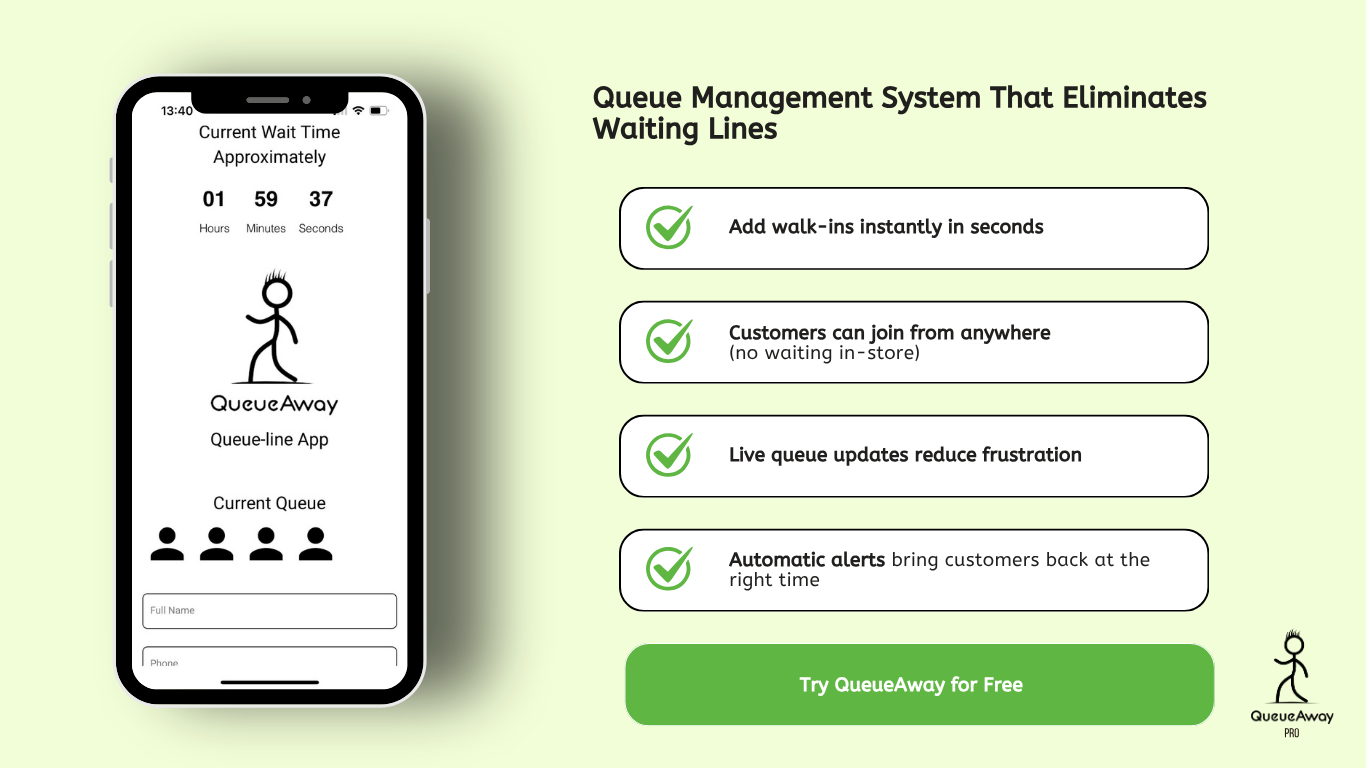
Many busy shops now use a virtual queue app that allows customers to join remotely, track their position and return when they are nearly next.
A good barbershop queue should tell customers:
that they have joined successfully,
where they are in the queue,
roughly how long they will wait,
when they are getting close,
when they should return.
This is where digital queue systems can improve the experience without removing the walk-in feel.
Instead of sitting in the shop for the whole wait, customers can join the queue from their phone, see their position, and come back when they are close to being called.
Why Physical Waiting Areas Can Put Customers Off
Traditional waiting areas create a few common problems.
First, they make the shop look busier than it may actually be. A customer looking through the window might see six people waiting and assume the wait is too long, even if two are with friends or one is waiting for a child.
Second, they increase pressure inside the shop. Barbers feel watched. Customers keep asking how long is left. The atmosphere becomes more stressful.
Third, they limit customer freedom. Nobody wants to spend their Saturday sitting in a crowded waiting area if they could be grabbing a coffee, shopping nearby or waiting in the car.
A virtual waiting room solves this by separating “being in the queue” from “physically sitting in the shop”.
How a Digital Queue System Helps Barbershops
A barber queue system gives both staff and customers a clearer view of the day.
For customers, it means:
joining by QR code or link,
seeing their live position,
getting an estimated wait time,
receiving updates when they move up,
returning when they are nearly ready.
For staff, it means:
better control over walk-ins,
fewer repeated “how long?” questions,
a clearer view of who is waiting,
less pressure in the waiting area,
fewer missed customers.
This does not replace the personal feel of a barbershop. It protects it by removing the frustrating part of waiting.
Barbershop Queue Statistics Show a Clear Trend
The data points to one clear direction: customers want more control.
Online booking is already a major part of barbershop behaviour, with reporting 77.49% of appointments booked online. Industry bodies continue to track pressure across the hair, beauty, barbering and aesthetics sectors, showing that business owners are dealing with changing demand, staffing and operating challenges.
As customer expectations continue to evolve, more businesses are investing in a digital queue management system to reduce congestion and improve customer flow.
For barbershops, the opportunity is simple.
The shops that make waiting easier will have an advantage over shops that still rely on guesswork, paper lists or customers sitting in order without updates.
The Future of Barbershop Queues
The future of barbershop queuing is not about removing walk-ins.
It is about making walk-ins work better.
Customers still want flexibility. Barbers still want busy shops. But both sides benefit when the queue is visible, organised and fair.
A modern barbershop queue system helps customers join, wait and return without stress. It helps staff manage demand without losing control of the shop floor. And it helps owners reduce the silent revenue loss caused by walk-outs.
For busy barbershops, the queue is not just an operational detail. It is part of the customer experience.
And in 2026, customer experience starts before the haircut begins.
Frequently Asked Questions
What is a barbershop queue system?
A barbershop queue system helps manage walk-ins and waiting customers by organising the queue digitally. Customers can join a queue remotely, track their position and receive updates when it is nearly their turn.
Why do barbershops need queue management?
Queue management helps barbershops reduce overcrowding, improve customer experience and minimise walk-outs caused by long or unclear waiting times. It also gives staff more control during busy periods.
How can barbershops reduce customer walk-outs?
Barbershops can reduce walk-outs by giving customers accurate wait times, live queue visibility and the ability to leave and return when they are nearly next. Virtual queue systems help remove uncertainty from the waiting experience.
Do customers still prefer walk-in barbershops?
Many customers still prefer walk-in barbershops because they offer flexibility and convenience. However, modern customers increasingly expect digital tools such as online queues, estimated wait times and mobile notifications.
What is a virtual waiting room for barbershops?
A virtual waiting room allows customers to join a barbershop queue digitally and wait elsewhere instead of sitting inside the shop. Customers can track their live queue position and receive updates when it is nearly their turn.
What are the busiest times for barbershops?
Barbershops are usually busiest on Fridays, Saturdays, before holidays and during school breaks. These peak periods often create longer queues and increased waiting times.
How does a virtual queue app work in a barbershop?
A virtual queue app allows customers to scan a QR code or join online, enter their details and see their live position in the queue. Customers receive updates and can return when their appointment or walk-in slot is approaching.
Can a queue management system improve customer experience in a barbershop?
Yes. A queue management system improves customer experience by reducing uncertainty, shortening perceived wait times and allowing customers to wait more comfortably outside the shop.