

How to Manage Walk-Ins in a Busy Barbershop (Stop Customers Walking Out)
If you run a busy barbershop, you already know the pattern.
Friday afternoon.
Saturday morning.
School holidays.
Payday weekends.
The shop fills up fast.
Chairs are full.
People are standing.
New walk-ins look around… and sometimes quietly leave.
Not because the haircut isn’t good — but because the waiting experience feels uncertain. Busy barbershops lose customers not because they’re full — but because the wait feels unclear.
Managing walk-ins properly is one of the biggest profit levers in a barbershop. And most shops still handle it the old way. Using an online queue system allows barbershops to manage walk-ins more efficiently without overcrowding the shop.
Let’s fix that. Lets talk about how many modern shops now use a digital queue for barbershops to reduce uncertainty in their barbershops.
Why Walk-Ins Are So Hard to Manage in Barbershops
Barbershops are different from most retail businesses.
They have:
Predictable peak times
Limited physical space
Variable haircut durations
Customers making stay-or-leave decisions within 30 seconds
Unlike restaurants, you don’t take names formally.
Unlike salons, you often don’t run full appointments.
So queues form informally.
And informal queues create problems:
Customers don’t know how long they’ll wait
Staff constantly answer “How long roughly?”
People walk out without saying anything
Regulars feel overlooked
The shop looks overcrowded even when wait times are manageable
That uncertainty costs money.
The Hidden Cost of Poor Walk-In Management
Let’s break it down.
If just 3 customers per busy Saturday walk out…
At an average £20–£25 haircut:
That’s £60–£75 per day.
Over 50 peak Saturdays per year?
£3,000–£4,000 lost annually.
And that’s conservative.
Now add:
Lost future loyalty
Negative perception (“It’s always rammed in there”)
Staff stress
Reduced retail upsell
Most shops don’t realise they’re leaking revenue through poor queue visibility and shops that introduce a structured queue management system often see fewer walk-outs and smoother peak-hour flow.
Traditional Walk-In Systems (And Why They Break at Scale)
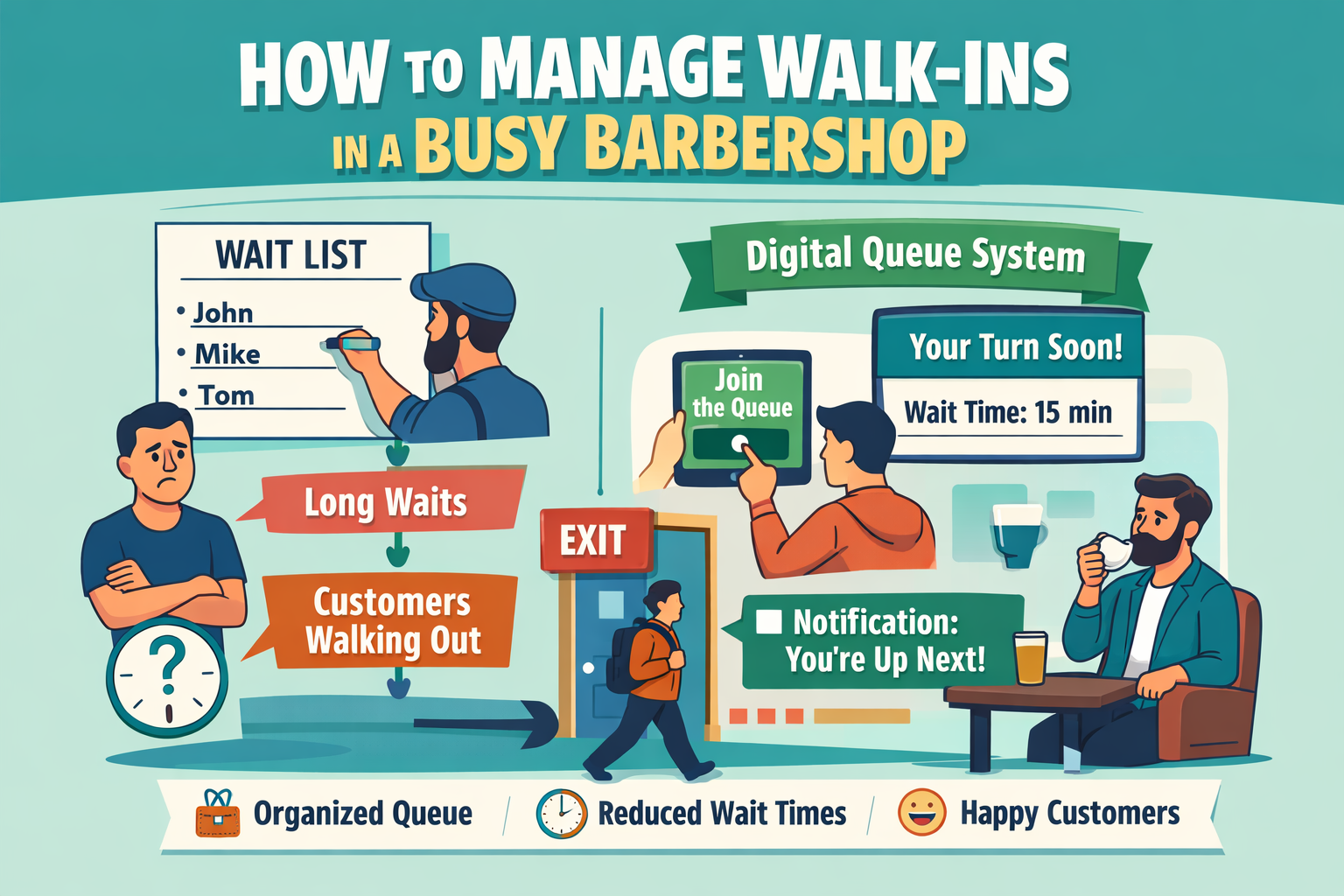
The Whiteboard List
Common in independent shops.
Pros:
Simple
Cheap
Visible order
Cons:
No time estimates
Still requires customers to stay
Looks chaotic during peak times
Doesn’t reduce crowding
The “Just Wait There Mate” System
No list.
No board.
Just mental tracking.
Works when:
2–3 people are waiting
Breaks when:
8+ people are in the shop
Multiple barbers are mid-cut
New walk-ins arrive in clusters
It increases friction and confusion.
Appointment-Only Switch
Some shops react by going fully appointment-only.
This solves waiting — but creates new issues:
Kills spontaneous trade
Turns away impulse walk-ins
Adds admin
Reduces flexibility
For many barbershops, walk-ins are still the lifeblood.
So the real solution isn’t removing walk-ins.
It’s managing them properly.
The Modern Solution: Digital Queue Management
Instead of making customers physically stand in line, modern shops use a digital queue for barbershops.
Here’s how it works:
Customer walks in
Joins queue via tablet or QR code
Sees estimated wait time
Leaves to grab coffee if they want
Gets notified when they’re near the top
Now:
The shop feels calm.
The queue is organised.
Customers feel in control.
And importantly:
You don’t lose walk-ins just because the shop looks full.
Why Digital Queues Work Specifically for Barbershops
You’re not a hospital.
You’re not a bank.
You’re not a theme park.
Barbershops have:
Fast service turnover
High repeat visits
Strong community feel
High sensitivity to “busy perception”
A digital queue doesn’t change your culture.
It simply makes the waiting transparent.
That one change:
Reduces walk-outs
Reduces “How long?” questions
Increases perceived professionalism
Allows customers to wait elsewhere
What to Look for in a Digital Queue for Barbershops
Not all queue systems are built for your environment.
You want something that:
Is designed for walk-in flow
Requires no complicated booking calendar
Shows realistic wait estimates
Works on mobile
Is simple for staff to manage
Doesn’t disrupt your workflow
If you’re evaluating options, look for systems built specifically for barbershops — not generic enterprise queue software.
How a Digital Queue Increases Revenue (Realistically)
Let’s be practical.
If you:
Reduce walk-outs by even 2 per day
Improve peak-hour retention
Create better flow
You can:
Serve more customers per peak window
Retain more new clients
Increase repeat visits
Improve online reviews
Often, the system pays for itself purely through retained traffic.
Common Concerns (And Why They’re Usually Myths)
“My customers won’t use it.”
They already use QR codes for menus, payments, and parking.
“It’ll feel too corporate.”
It actually feels more organised and modern.
“We’re too small for that.”
Small shops benefit the most because space is limited.
“We’ve always done it this way.”
So did most shops before contactless payments.
Step-By-Step: Transitioning Without Disruption
Introduce tablet/QR joining
Keep existing flow temporarily
Train staff to explain it in one sentence
Add signage
Monitor walk-out reduction
Within 2–4 weeks, it becomes normal.
The Bottom Line
Managing walk-ins properly isn’t about being high-tech.
It’s about reducing uncertainty.
Busy shops don’t lose customers because they’re busy.
They lose customers because the wait feels unclear.
If you want to keep walk-ins, reduce stress, and modernise your experience, a digital queue for barbershops is no longer a luxury — it’s becoming standard.
Frequently Asked Questions About Managing Walk-Ins in a Barbershop
How do barbershops manage walk-ins efficiently?
Barbershops manage walk-ins efficiently by creating a clear and structured waiting process. This can include visible waiting lists, realistic time estimates, and increasingly, digital queue systems that allow customers to join remotely and receive updates when they’re near the top of the queue.
The key is reducing uncertainty — when customers understand how long they’ll wait, they’re far less likely to leave.
Why do customers walk out of busy barbershops?
Customers rarely walk out simply because a shop is busy. They leave when the wait feels unclear or unpredictable.
If a new walk-in can’t tell whether the wait is 10 minutes or 45 minutes, they’re more likely to leave and try elsewhere. Improving visibility and queue transparency significantly reduces walk-outs.
Can small barbershops use a digital queue system?
Yes. In fact, smaller barbershops often benefit the most.
Limited floor space can make busy periods feel overcrowded. A digital queue allows customers to join, see an estimated wait time, and wait elsewhere — reducing congestion and improving overall flow without removing walk-ins.
Many modern shops now use a digital queue for barbershops to organise busy periods without switching to full appointments.
Does using a digital queue mean switching to appointments?
No. A digital queue does not replace walk-ins — it simply structures them.
Customers still arrive as normal. The difference is that instead of standing and waiting with no information, they join a structured system that provides estimated wait times and updates.
This preserves the walk-in model while improving the customer experience.
How can I reduce waiting time in a busy barbershop?
Reducing waiting time starts with understanding peak demand patterns. Busy shops can:
Adjust staff schedules around peak hours
Streamline services during rush periods
Communicate realistic wait estimates
Introduce a structured queue system
Allow customers to wait outside the shop
Often, improving how waiting is managed has a bigger impact than trying to shorten haircut times.