

How Long Queues Cost Retail Sales
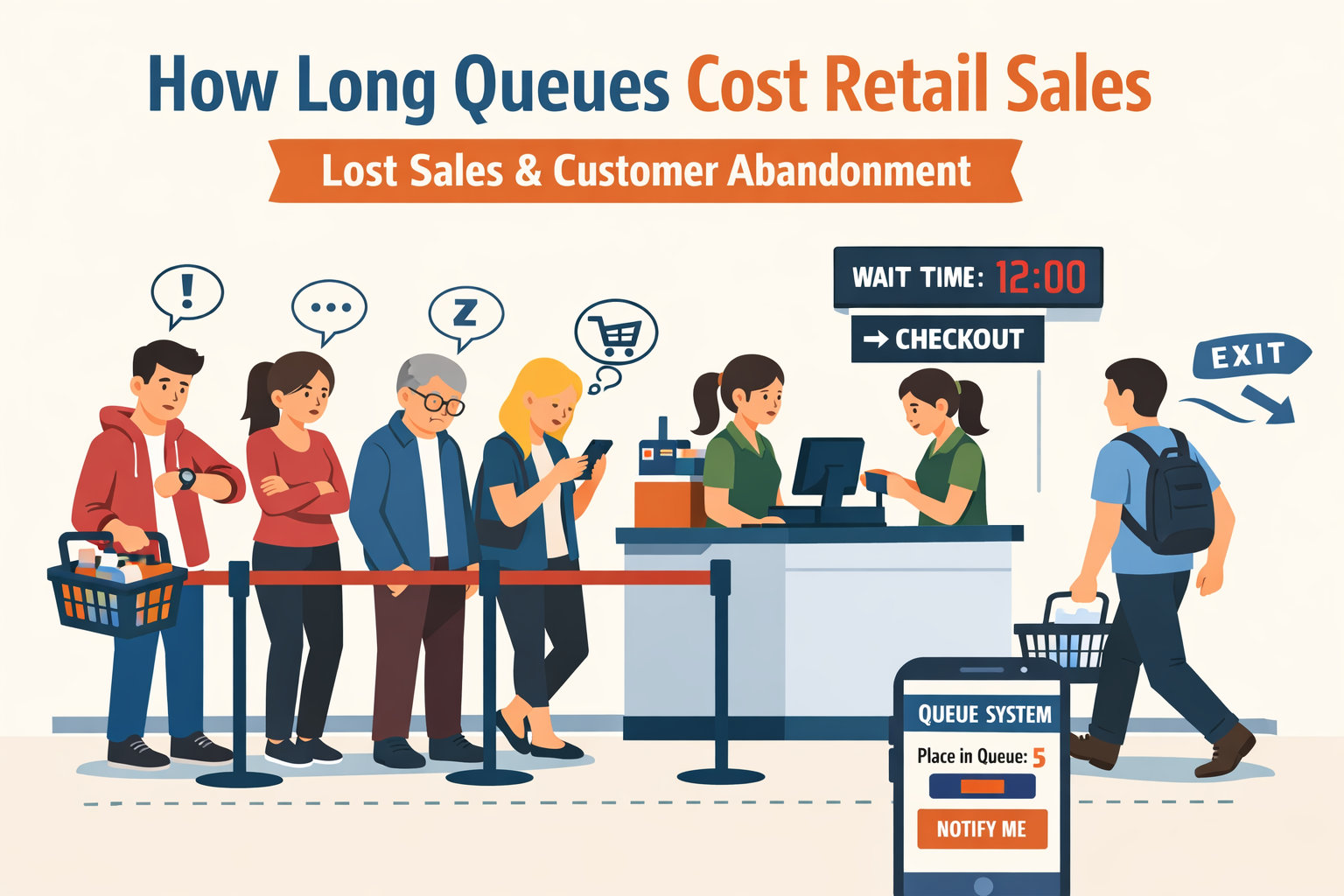
Retail queues may appear to be a small operational issue, but the reality is that waiting lines have a direct financial impact on retail businesses.
Every minute a customer spends waiting in line increases the chance they will abandon their purchase, walk out of the store, or choose a competitor next time. Many retailers are now turning to a queue management system for retail to reduce lost sales caused by long checkout queues.
In modern retail environments where speed, convenience, and experience drive customer loyalty, long queues are one of the fastest ways to lose sales. As queues continue to impact sales performance, many retailers are now investing in a queue management system in the US to reduce lost revenue and improve customer flow.
This article explores:
The real financial impact of queues on retail revenue
How long customers will tolerate waiting
The scale of queue abandonment in retail
Why managing customer flow is now essential for modern stores
The Hidden Cost of Retail Queues
Retailers often focus heavily on product pricing, merchandising, and marketing — but queue management is rarely treated as a revenue driver.
Yet studies consistently show that long queues directly reduce store sales.
Research from global retail queue statistics and customer experience studies suggests:
Up to 70% of customers will abandon a purchase if checkout lines are too long.
1 in 3 shoppers have walked out of a store due to queues.
Retailers lose billions annually due to queue abandonment.
The impact is particularly severe during peak trading periods such as:
Weekends
Holiday shopping seasons
Promotional sales
Lunchtime rush periods
These are precisely the moments when stores should be capturing maximum revenue.
Instead, queues can cause the opposite effect. Data on average wait times in retail shows how quickly delays lead to customer frustration and lost revenue.
Queue Abandonment: The Moment Sales Are Lost
Queue abandonment occurs when a customer decides the wait is too long and leaves before completing their purchase. Long queues directly lead to queue abandonment in retail, where customers leave before completing their purchase.
This behaviour is one of the most direct ways queues impact retail profitability.
Typical abandonment triggers include:
Long visible checkout lines
Slow payment processing
Limited staff during busy periods
Poorly organised customer flow
When shoppers abandon a queue, the retailer loses more than just the current sale.
They may also lose:
Future purchases
Customer loyalty
Positive word-of-mouth
Once customers believe a store is “always busy” or “always slow”, they begin to shop elsewhere.
The Financial Impact of Lost Customers
Let’s consider a simple scenario.
Imagine a busy retail store serving 400 customers per day.
If just 5% of customers abandon the queue, that equals:
20 lost purchases per day.
If the average purchase value is $25, the store loses:
$500 per day in missed revenue.
Over a year, that becomes:
$182,500 in lost sales.
And this example only considers direct purchase abandonment, not long-term lost customers.
For large retail chains, the financial impact can reach millions in lost revenue annually. When delays directly translate into lost income, it becomes clear why understanding what is a queue management system is essential for modern retail businesses.
Customer Expectations Have Changed
Queues were once considered a normal part of shopping. Reducing queue times at scale often requires a modern queue management system that can manage customer flow across multiple locations.
Today, expectations are very different.
Modern consumers are used to:
Instant online checkout
One-click purchases
Fast digital services
Same-day delivery
When they walk into a store and encounter a long queue, it feels like a step backwards in convenience.
Studies show:
Customers are willing to wait around 5–8 minutes in retail.
After 10 minutes, abandonment rates increase rapidly.
Perceived waiting time often feels twice as long as actual waiting time.
Retailers improving customer flow in retail often see immediate reductions in lost sales and queue-related frustration.
Why Peak Times Create the Biggest Losses
Queues are most damaging during peak trading periods.
Common peak retail times include:
Friday afternoons
Saturday shopping hours
Seasonal sales
Christmas shopping weeks
Promotional events
During these periods:
Stores experience higher footfall
Checkout demand spikes
Staff may become overwhelmed
Ironically, the busiest times — when retailers should generate the most revenue — are when queues cause the most lost sales. Many customers will simply leave if queues become too long.
Effective queue management during these periods can significantly increase revenue capture.
The Psychology Behind Queue Frustration
Queue frustration is not only about waiting time.
Customers also react to how the queue feels.
Several psychological factors influence whether a customer will stay or leave:
Visibility of the queue
Long visible lines can discourage customers before they even join.
Uncertainty
Not knowing how long the wait will be increases frustration.
Perceived fairness
Customers become frustrated if they believe others are being served faster.
Idle time
Waiting with nothing to do feels longer than occupied waiting.
Retailers that understand these psychological triggers can dramatically improve the customer experience even without reducing actual wait times.
How Retailers Are Reducing Queue Losses
Retailers are increasingly adopting technology and new customer flow strategies to reduce queue-related sales loss.
Common solutions include:
Virtual queue systems
Customers join a digital queue using their phone or in-store kiosk. They can continue shopping while waiting.
Mobile checkout
Staff equipped with mobile payment systems can process purchases anywhere in the store.
Self-checkout lanes
Self-service technology helps distribute checkout demand during busy periods.
Real-time queue monitoring
Retailers can monitor queue lengths and open additional service points when needed.
These solutions help capture sales that would otherwise be lost to waiting frustration. To address this, businesses are increasingly adopting queue management systems for businesses to streamline operations, reduce wait times, and maximise conversions.
The Rise of Queue Management Systems
Queue management systems are becoming a critical part of modern retail operations.
Rather than forcing customers to stand in line, these systems:
Digitally manage waiting lists
Notify customers when it’s their turn
Allow shoppers to continue browsing
Provide real-time queue visibility
This approach transforms the waiting experience from frustrating downtime into productive shopping time.
Retailers using queue management technology often report:
Reduced queue abandonment
Higher customer satisfaction
Increased average spend
Improved staff efficiency
Waiting Lines Are a Revenue Problem
Retail queues are not just an inconvenience — they are a direct revenue risk.
Every abandoned queue represents:
Lost revenue
Lost customer trust
Lost future business
Retailers that actively manage customer flow are far better positioned to:
Capture peak demand
Improve customer experience
Increase sales per visitor
In a retail environment where customer expectations continue to rise, queue management solutions has become a competitive advantage, and in today’s retail environment, reducing queues isn’t just about customer experience — it’s a direct driver of revenue, efficiency, and long-term growth.
Businesses that solve waiting problems can turn queues from a liability into a smoother, more profitable customer journey. If you're losing sales due to long queues, QueueAway provides a powerful queue management system for retail designed to reduce wait times and maximise in-store conversions.
FAQ Section
How do queues affect retail sales?
Queues directly impact retail sales because customers may abandon their purchase if the wait is too long. Studies suggest up to 70% of shoppers may leave a queue if it exceeds their tolerance.
How long will customers wait in a retail store?
Most customers are willing to wait around 5–8 minutes in retail environments. After about 10 minutes, queue abandonment rates increase significantly.
What is queue abandonment in retail?
Queue abandonment occurs when a customer leaves a checkout line before completing their purchase due to long waiting times.
Why do long queues frustrate customers?
Long queues create frustration due to uncertainty, perceived unfairness, idle waiting time, and visible crowding at checkout areas.
How can retailers reduce queue abandonment?
Retailers can reduce abandonment by using virtual queues, self-checkout systems, mobile payment solutions, and queue management technology