

Retail Queue Statistics (2026): Wait Times, Abandonment & Lost Sales Data
Retail queues are one of the most overlooked drivers of customer satisfaction and lost revenue. While retailers often focus on product selection, pricing, and marketing, the in-store waiting experience can dramatically influence whether customers complete a purchase or walk away. Retailers are increasingly turning to a queue management system for retail to reduce wait times and improve customer experience based on recent data.
Recent retail queue statistics show that long wait times remain one of the biggest drivers of customer frustration and lost sales in physical stores.
In busy retail environments, queues form quickly — at checkouts, service desks, fitting rooms, returns counters, and customer service points. When waiting lines become too long or poorly managed, customers may abandon their purchases entirely. The data clearly shows how different types of queuing systems impact customer behaviour, especially during peak retail hours.
This 2026 analysis brings together retail studies, industry research, and consumer behaviour reports to reveal how queues impact modern retail businesses, and why customers abandon retail checkout lines.These retail queue statistics highlight why many retailers are now adopting a queue management system in the US to reduce waiting times and improve customer experience.
In this report we explore:
The understanding average checkout wait times in retail stores helps explain why queues affect customer behaviour.
Queue abandonment rates
How long customers are willing to wait
The financial cost of poor queue management
Consumer behaviour when facing long lines
Why digital queue in retail are transforming retail
What Do Retail Queue Statistics Show in 2026?
Here are some of the most important queue-related statistics affecting retail businesses today:
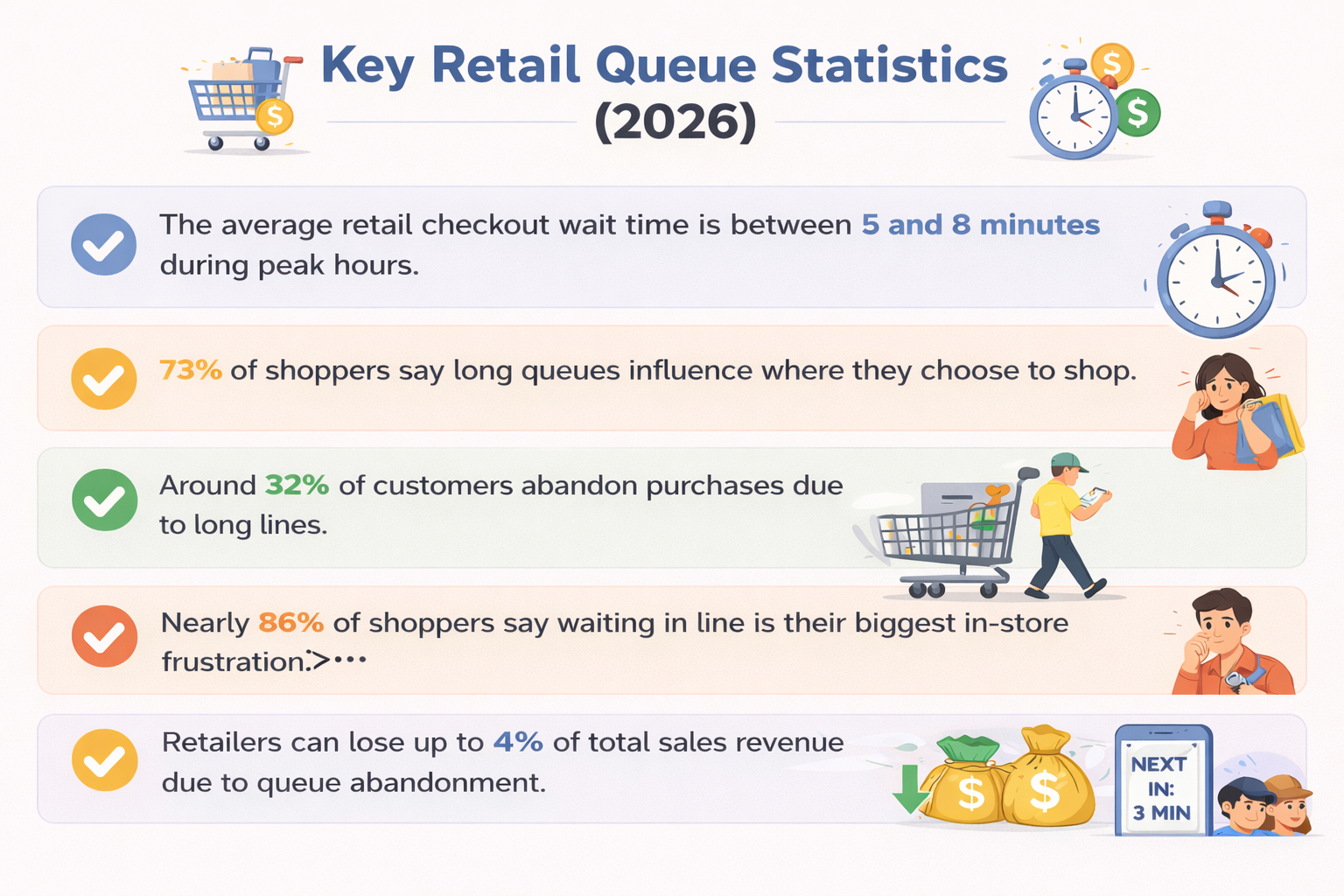
• The average checkout wait times in retail checkout wait time is between 5 and 8 minutes during peak shopping hours.
• 73% of shoppers say long queues influence where they choose to shop.
• Around 32% of customers abandon purchases due to long lines.
• Nearly 86% of shoppers say waiting in line is their biggest in-store frustration.
• Retailers can lose up to 4% of total sales revenue due to queue abandonment.
• Millennials and Gen Z are the least tolerant of waiting, with many abandoning queues after just 3–5 minutes.
• Stores that implement queue management technology report up to 30% shorter perceived wait times.
These figures highlight an important shift in retail: waiting experience is now part of the customer experience.
Average Wait Times in Retail (Latest Data)
Retail waiting times vary widely depending on store size, staffing levels, and time of day.
Typical wait times observed across retail environments include:
Retail Environment
Supermarkets
Clothing retailers
Electronics stores
Customer service desks
Holiday shopping periods
Average Wait Time
3–6 minutes
4–7 minutes
5–10 minutes
8–15 minutes
10–20 minutes
During peak retail events such as Black Friday or Christmas shopping, queues can become significantly longer, sometimes exceeding 30 minutes in high-traffic stores.
However, research consistently shows that customer patience does not increase with queue length.
Instead, customers are far more likely to abandon purchases.
Retail Queue Abandonment Rates Explained
Queue abandonment occurs when customers leave a queue before completing their purchase.
This behaviour is extremely common in retail environments where queues are visible and unpredictable.
Studies indicate:
• Around 1 in 3 shoppers abandon a purchase when queues appear too long.
• Large visible queues deter new customers from entering the store.
• Queue abandonment increases dramatically after 7 minutes of waiting. When customer expectations are this high, understanding what is a queue management system becomes essential for retailers looking to stay competitive.
This is particularly damaging for retailers because abandonment often involves fully selected shopping baskets.
In many cases the retailer has already succeeded in attracting the customer and convincing them to shop — but loses the sale at the final stage.
Customer Behaviour in Retail Queues
Customer tolerance for queues has declined significantly in recent years.
Digital services, fast delivery expectations, and mobile-first experiences have created a culture of instant gratification.
Research shows the following wait tolerance levels:
Customer Segment
3–5 minutes
4–6 minutes
6–8 minutes
8–10 minutes
Maximum Wait Tolerance
Gen Z
Millennials
Gen X
Baby Boomers
This generational difference is becoming more important as younger shoppers become the dominant retail audience.
Retailers that fail to modernise queue management risk losing these customers entirely. Average wait time data further highlights the scale of the issue.
How Queues Impact Retail Sales and Revenue
Long queues do not only frustrate customers — they also have a measurable financial impact. A virtual queue system helps retail stores control peak-time traffic while improving the overall shopping experience.
Retail queue issues can lead to:
Lost purchases
Customers abandon baskets or leave stores.
Reduced repeat visits
Shoppers avoid stores where queues are common.
Negative word-of-mouth
Customers share poor experiences with friends and online.
Reduced staff productivity
Employees spend time managing queues instead of helping customers.
Across large retail chains, these issues can result in millions in lost annual revenue.
Why Queue Perception Matters
Interestingly, research shows that perceived waiting time is often more important than actual waiting time.
Customers are more tolerant when:
• They understand their place in line
• How long the customers know their wait in retail stores
• They can spend their waiting time productively
This is why many modern retailers are adopting digital queue management solutions that allow customers to join a queue virtually rather than standing in line.
For example, a modern retail queue management system allows customers to:
Join a queue using their phone
Receive notifications when their turn is approaching
Browse the store instead of standing in line
This significantly improves the overall shopping experience. To address these challenges, retailers are increasingly using queue management systems for businesses to manage demand and improve service efficiency.
Customer Behaviour in Retail Queues
Customer behaviour in queues tends to follow predictable patterns.
When shoppers see a long queue they often:
Estimate the number of people ahead of them
Judge how fast the queue is moving
Compare it with alternative stores
Decide whether the purchase is worth the wait
If the queue appears slow or unpredictable, customers are far more likely to leave.
Retail environments where queues are visible and unmanaged often suffer the highest abandonment rates.
How Retailers Reduce Wait Times (With Data)
Many retailers are now replacing traditional queues with digital systems.
Instead of forming physical lines, customers can join a queue remotely and continue shopping until they are called.
Modern queue management platforms allow retailers to:
• Reduce visible queues
• Improve customer flow
• Provide accurate wait time estimates
• Reduce queue abandonment
• Increase overall store efficiency
These systems are increasingly used in:
Apple stores
technology retailers
telecom stores
fashion retailers
customer service counters
Retailers implementing digital queue technology often see improvements in both customer satisfaction and sales conversion rates.
Why Retail Queue Management Is Becoming a Competitive Advantage
As retail competition increases, customer experience becomes a key differentiator.
Long queues represent a point of friction that many retailers still overlook.
Stores that optimise queue flow gain advantages such as:
Faster customer service
Better store atmosphere
Increased purchase completion
Improved customer loyalty
This is why queue management systems are becoming increasingly common in modern retail operations.
Key Retail Queue Statistics Summary (2026)
A Retail queue management system may seem like a small operational detail, but they have a powerful influence on customer behaviour and sales outcomes.
The statistics are clear:
Customers have low tolerance for waiting
Queue abandonment is extremely common
Visible queues discourage new shoppers
Poor queue management can lead to measurable revenue loss
Retailers that improve the waiting experience — either through better staffing, smarter queue layouts, or digital queue management solutions — can significantly improve both customer satisfaction and sales performance. If you're looking to act on these insights, QueueAway provides a powerful queue management system for retail designed to reduce wait times and improve in-store efficiency.
FAQ Section
What is queue abandonment in retail?
Queue abandonment occurs when a customer leaves a queue before completing a purchase, usually due to long wait times or slow service.
How long will customers wait in retail queues?
Most customers are willing to wait between 3 and 8 minutes depending on age group and store type.
Why are long queues bad for retail stores?
Long queues can lead to abandoned purchases, reduced customer satisfaction, and negative brand perception.
How can retailers reduce queue waiting times?
Retailers can reduce wait times by improving staffing, adding more checkout points, or implementing digital queue management systems.